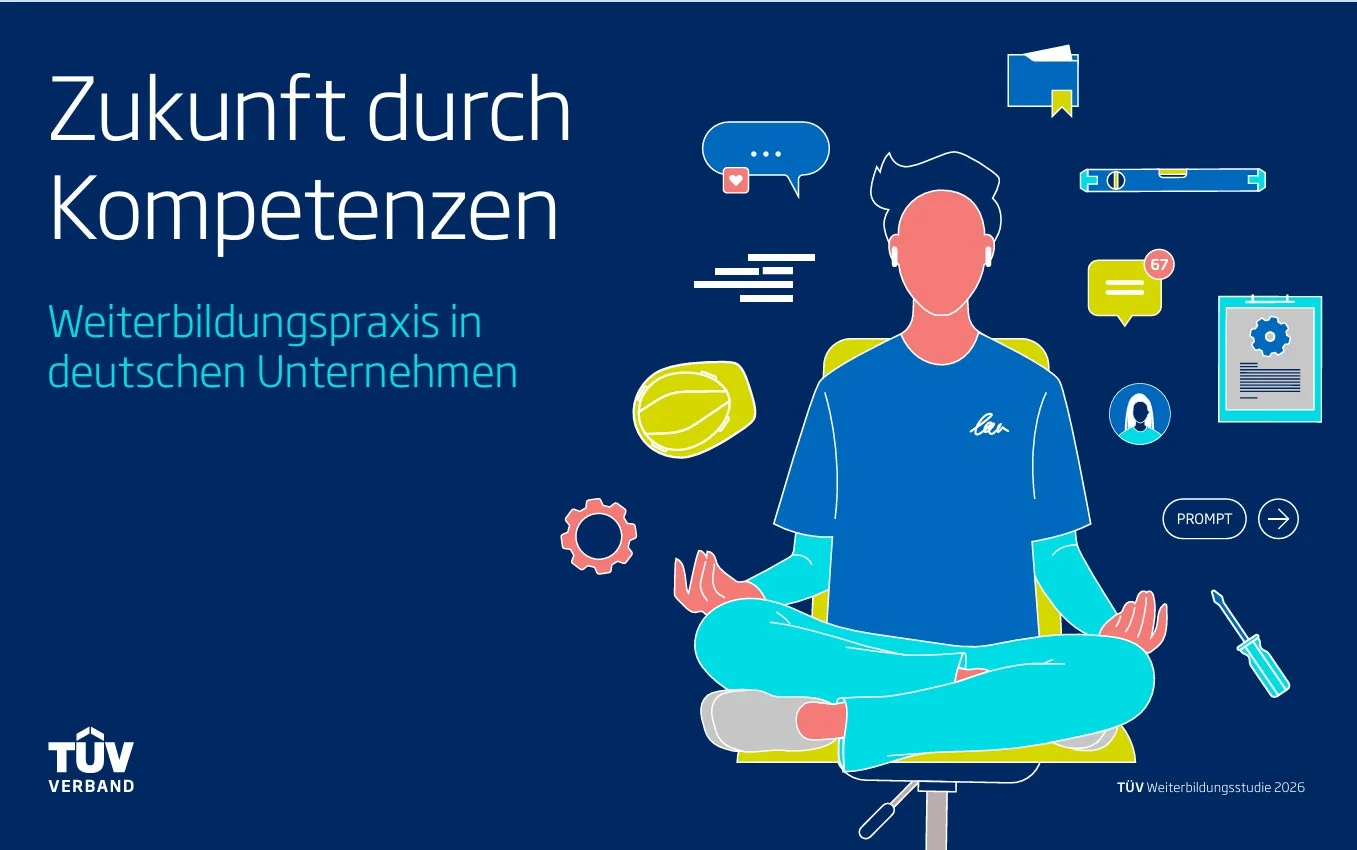
Skills shortages, digitalization, artificial intelligence: the challenges facing German companies are immense. A new study by TÜV-Verband shows the real state of workplace training – and why so many are choosing exactly the wrong moment to dial back on learning.
same thing: yes, of course development is important. That the reality often looks rather different is documented in the TÜV Training Study 2026, commissioned by TÜV-Verband and conducted by forsa among 500 German companies. The result is a nuanced picture – with some alarming gaps.
Eighty-seven percent of companies surveyed consider employee training to be important or very important. That sounds positive. Yet compared to the 2024 edition of the study, this figure has dropped by six percentage points. And while enthusiasm for training is cooling, the share of companies offering no development opportunities at all has grown from four to six percent – a small but symbolically significant shift.
Strategic anchoring of training is a minority sport: just 29 percent of companies have a written training strategy. Larger organizations fare better, as expected – among employers with 250 or more staff, the figure rises to 45 percent, and to 53 percent in public administration. In manufacturing, only 20 percent have committed their approach to paper.
That said, the lived learning culture in many organizations is better than the formal structures might suggest. Nine in ten respondents say mistakes are treated as learning opportunities. Eighty-six percent report that managers actively support training activities. And in the majority of companies, line managers are explicitly required to discuss individual development options with their teams on a regular basis.
When it comes to budgets, things get tighter. Two thirds of companies allocate a maximum of €1,000 per employee per year for training. Fifty-one percent offer three to five working days annually for development. This sounds reasonable, but is slightly lower than in 2024: back then, 16 percent of companies were granting more than nine days; today that figure has halved to eight percent. The trend is downward.
In terms of format, most companies stick with what they know: 81 percent use face-to-face sessions, 71 percent use online formats, and more than half combine both through blended learning. Among digital formats, webinars and virtual live sessions dominate – nine in ten digitally active companies use this approach. AI-powered learning systems, by contrast, are used by just 15 percent.
What does training actually deliver? Companies are remarkably aligned on this question: 91 percent say it helps them meet legal and regulatory requirements, 88 percent see a positive impact on productivity and efficiency, and 86 percent use training deliberately to position themselves as attractive employers – a compelling argument in an era of skills shortages.
On the competency side, the study paints a clear picture: digital skills (56 percent) and leadership capabilities (54 percent) represent the biggest gaps. Almost half of all companies also see a need for stronger social skills – communication, creativity, and teamwork. Among so-called future skills, social and human competencies top the list at 88 percent, followed by digital skills (70 percent) and transformative abilities such as innovation and adaptability (59 percent).
Particularly illuminating is the data on artificial intelligence. Fifty-six percent of companies surveyed are already using generative AI tools such as ChatGPT, Gemini, or Copilot in their daily operations. Among AI users, 54 percent report efficiency gains, and 40 percent already perceive shifts in competitive dynamics within their sector.
Yet while usage is rising, upskilling is lagging behind. The share of companies that have already provided AI training for employees has more than doubled compared to 2024 – from 12 to 27 percent. But 45 percent currently see no need for AI-related training, even though 50 percent simultaneously identify a high or very high development need in this area. This gap between recognized need and actual action is the structural problem the study lays bare.
For 72 percent of those who see a need for AI training, application-oriented skills are the priority – that is, practical competence in using AI tools day-to-day. Two thirds also want a grounding in how the technology actually works. AI skills as a hiring criterion barely register: they are required in at most five percent of new positions.
Companies see the skills shortage (75 percent) as their single greatest threat to organizational resilience, ahead of regulatory pressure (67 percent), IT outages (65 percent), and cyberattacks (62 percent). To strengthen resilience, many are targeting training in cybersecurity (53 percent), market intelligence (49 percent), and crisis management (48 percent).
Responsibility for training is placed almost unanimously with employers themselves (98 percent) and with employees (86 percent). Government ranks much lower at 47 percent – and receives correspondingly little praise: 67 percent are dissatisfied with public funding options, and 76 percent feel poorly informed about available support. Just 15 percent believe policymakers are on the right track when it comes to developing future skills.
The study’s conclusion is as clear as it is uncomfortable: the willingness to treat training as a strategic investment is there – but consistent follow-through is not. At a time when technological change, talent scarcity, and geopolitical uncertainty are hitting companies simultaneously, this is a risk that may prove costly. Those who cut corners on learning today will pay in competitive disadvantage tomorrow.

Dr. Jakob Jung is Editor-in-Chief of Security Storage and Channel Germany. He has been working in IT journalism for more than 20 years. His career includes Computer Reseller News, Heise Resale, Informationweek, Techtarget (storage and data center) and ChannelBiz. He also freelances for numerous IT publications, including Computerwoche, Channelpartner, IT-Business, Storage-Insider and ZDnet. His main topics are channel, storage, security, data center, ERP and CRM.
Contact via Mail: jakob.jung@security-storage-und-channel-germany.de