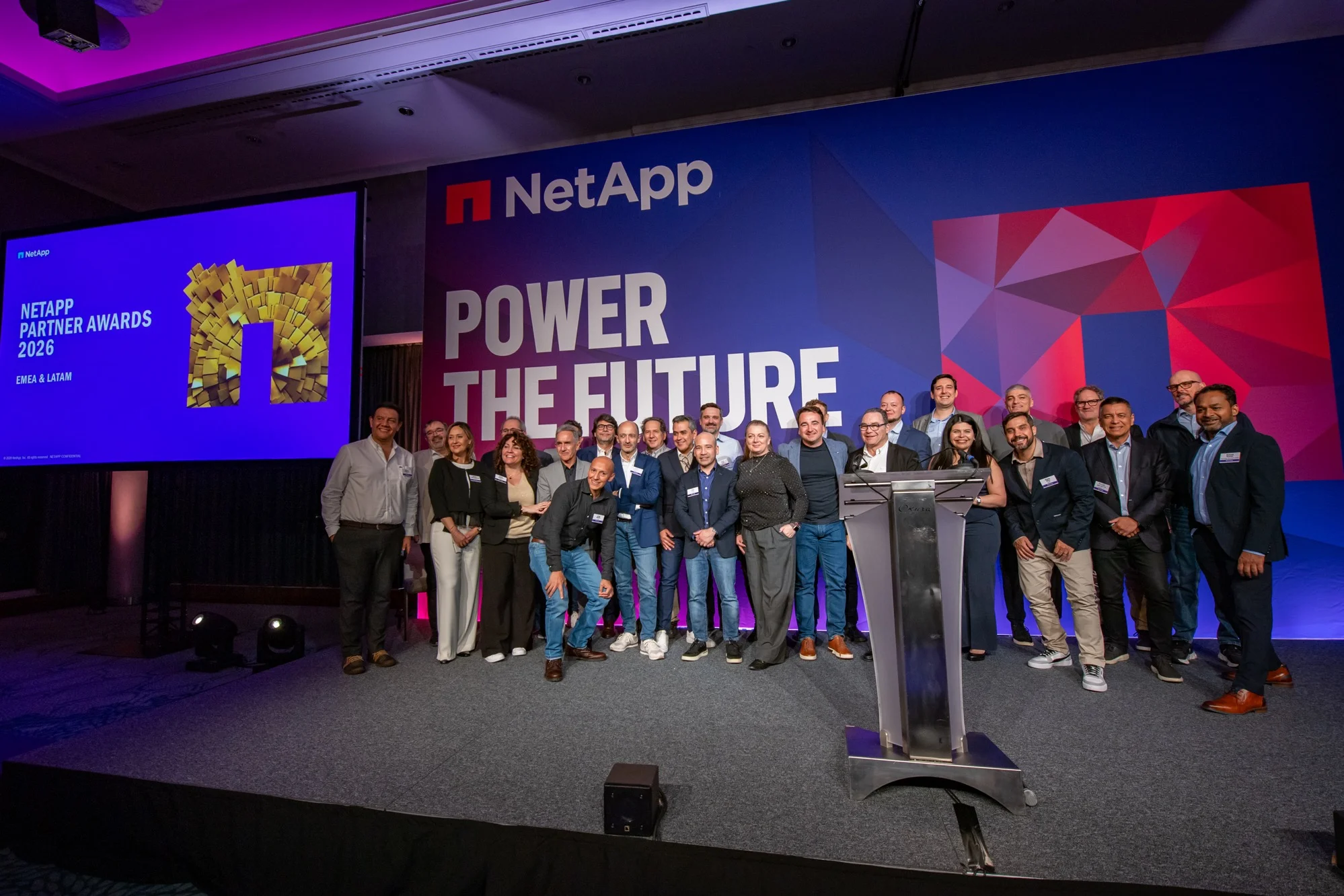
At its EMEA & LATAM Partner Summit in Amsterdam, NetApp confronted partners with a frank assessment: flash storage has become twenty times more expensive than hard disk, supply chains remain disrupted for at least six months, and European customers are actively reconsidering their dependence on US cloud providers. Against that backdrop, the company unveiled its AI Data Engine and positioned its partner ecosystem as the primary channel for navigating the turbulence.
Some 200 channel partners gathered at the Okura Hotel in Amsterdam for NetApp’s annual EMEA & LATAM Partner Summit and Awards, and the mood was one of urgency rather than celebration. Before the partner excellence trophies were handed out, senior executives and an independent industry analyst spent the morning laying out a set of pressures — supply, pricing, geopolitics, sovereignty — that they described as without recent precedent.
Willem Hendrickx, SVP and General Manager for NetApp EMEA & LATAM, opened the session by addressing the supply chain situation directly. Flash storage now costs approximately twenty times more than hard disk drives, a ratio that has inverted the assumptions underpinning many enterprise storage decisions. ‘I have never seen such a situation before,’ Hendrickx told the audience. The company does not expect conditions to normalise within the next six months, a timeline that has direct consequences for partner pipelines and customer procurement cycles.
Hendrickx said the disruption stems from the AI infrastructure build-out: hyperscalers have absorbed memory and high-density flash at a scale that has compressed supply across the broader market. Vendors are adjusting prices, some shipments have been cancelled, and delivery windows have extended significantly. NetApp’s response, he said, is transparency with both customers and partners, and an offer to help balance cost by serving both HDD and SSD workloads — a portfolio breadth that few pure-flash competitors can match.
Gavin Moore, CTO for EMEA & LATAM, reinforced the economic argument. ‘Flash is better than disks, but the economics have changed twenty-fold,’ he said, adding that customers are actively requesting disk-based options for cost-sensitive tiers. Moore also announced a forthcoming software-only release of ONTAP, the company’s core storage operating system, due in June, and a full refresh of the E-Series hardware line. He described ONTAP’s metadata capabilities as the foundation that makes NetApp storage ‘AI-ready’ before any model is deployed.
Analyst: Europe Is Structurally Repositioning
Alistair Edwards, Chief Analyst at Omdia, provided an external frame for the supply pressures. He identified four macro trends reshaping the technology market: geopolitical turbulence; a supply and pricing dislocation he described as worse than anything seen during the Covid-era component shortage; European demand for resilience and digital sovereignty; and a CEO-level shift toward risk mitigation that now encompasses data sovereignty and asset ownership, not merely cybersecurity.
Edwards noted that the French government is among those moving procurement away from US-headquartered vendors, and that similar reassessments are underway across both public-sector and enterprise buyers. He was direct about the complexity of the shift: departing from US hyperscalers is structurally difficult, but the political and regulatory environment is creating pressure to do so regardless. For partners, he said, this creates a significant advisory opportunity — provided they can maintain the trust and credibility that supply disruptions are currently placing under strain. ‘Pipelines will shrink, even when customers order, delivery times are a lot longer,’ he said, characterising the near-term outlook for channel business as one in which profitability will suffer and less resilient partners will face real challenges.
Edwards also pointed to emerging service opportunities in cybersecurity and AI infrastructure, noting that the average enterprise now operates across three distinct service models and that the AI market is still in its early stages. Overall infrastructure market growth of around ten percent is projected for the current year, though the share of business flowing through the channel has declined — a trend he urged partners to reverse by positioning themselves across the full customer lifecycle.
Sovereignty as a Scale, Not a Binary
Adam Gale, Field CTO for MEA, gave a detailed account of how NetApp maps the sovereignty landscape for customers. He described sovereignty not as a single regulatory requirement but as a continuum ranging from physically air-gapped dark-site deployments used by defence customers, through certified sovereign cloud environments, to standard public cloud workloads with contractual data controls. NetApp, he argued, is the only major storage vendor capable of operating across that full spectrum — including the ability to move data between clouds without vendor lock-in, which he characterised as a significant differentiator.
Gale placed particular emphasis on autonomous ransomware protection, isolated recovery environments, and what he called ‘security by design’ — features built into the storage layer rather than added as external tools. He referenced the EU’s emerging cloud sovereignty frameworks and noted that NetApp is positioned to operate independently within EU jurisdictions, a capability that French and other European systems integrators are actively requesting. Proactive measures against quantum cryptography threats were also flagged as part of the forward-looking security roadmap.
AI Data Engine: From Pilot to Production
Kirsty Biddiscombe, AI Business Development Manager covering all EMEA partners, presented the commercial context for NetApp’s AI positioning. She cited Gartner data suggesting that sixty percent of enterprise AI projects are abandoned before reaching production, most frequently because the underlying data infrastructure was not prepared for the workload. Her argument was that the storage layer — not the model or the GPU cluster — is the primary constraint preventing AI pilots from scaling.
The centrepiece announcement was the AI Data Engine, developed in conjunction with Nvidia. The platform is designed to provide governance, security, and data guardrails at the infrastructure level, removing the need to build those controls separately into each AI application. Biddiscombe described its architecture as a ‘virtual data lake’ capable of supporting model training, fine-tuning, inferencing, and edge deployment from a single foundation. The move from human-supervised to agentic AI workflows — in which autonomous agents interact with data with less human oversight — was cited as the driver for tighter infrastructure-level governance.
ONTAP’s native metadata capabilities were positioned as the mechanism through which storage-level data becomes immediately usable for AI workloads, reducing the preparation overhead that typically delays production deployments. Moore had earlier described this as ‘adding metadata to be AI-ready at the storage level,’ a capability he said changes the economics of enterprise AI.
Partner Strategy and Awards
Hendrickx reiterated that 88 percent of NetApp’s EMEA business flows through the channel, and framed the partner-first strategy as structural rather than aspirational. ‘We honour our deal with partners,’ he said, acknowledging that the current pricing environment — in which the gap between flash and disk costs is likely to widen further — places partners in a difficult position with customers. He described the role of the trusted advisor as more valuable precisely because the market is harder to navigate.
The summit concluded with the FY26 EMEA & LATAM Partner Excellence Awards, recognising achievement across seven categories: Partner of the Year, Distributor of the Year, Regional Distributor of the Year, New Customer Acquisition Partner of the Year, Keystone Partner of the Year, Cloud or Hybrid Cloud Partner of the Year, and AI Partner of the Year. Individual recognition awards were also presented for top performers across the UK, France, Germany, Western Europe, and the EEMI region, with criteria centred on new customer acquisition and innovation leadership.
Dr. Jakob Jung is Editor-in-Chief of Security Storage and Channel Germany. He has been working in IT journalism for more than 20 years. His career includes Computer Reseller News, Heise Resale, Informationweek, Techtarget (storage and data center) and ChannelBiz. He also freelances for numerous IT publications, including Computerwoche, Channelpartner, IT-Business, Storage-Insider and ZDnet. His main topics are channel, storage, security, data center, ERP and CRM.
Contact via Mail: jakob.jung@security-storage-und-channel-germany.de