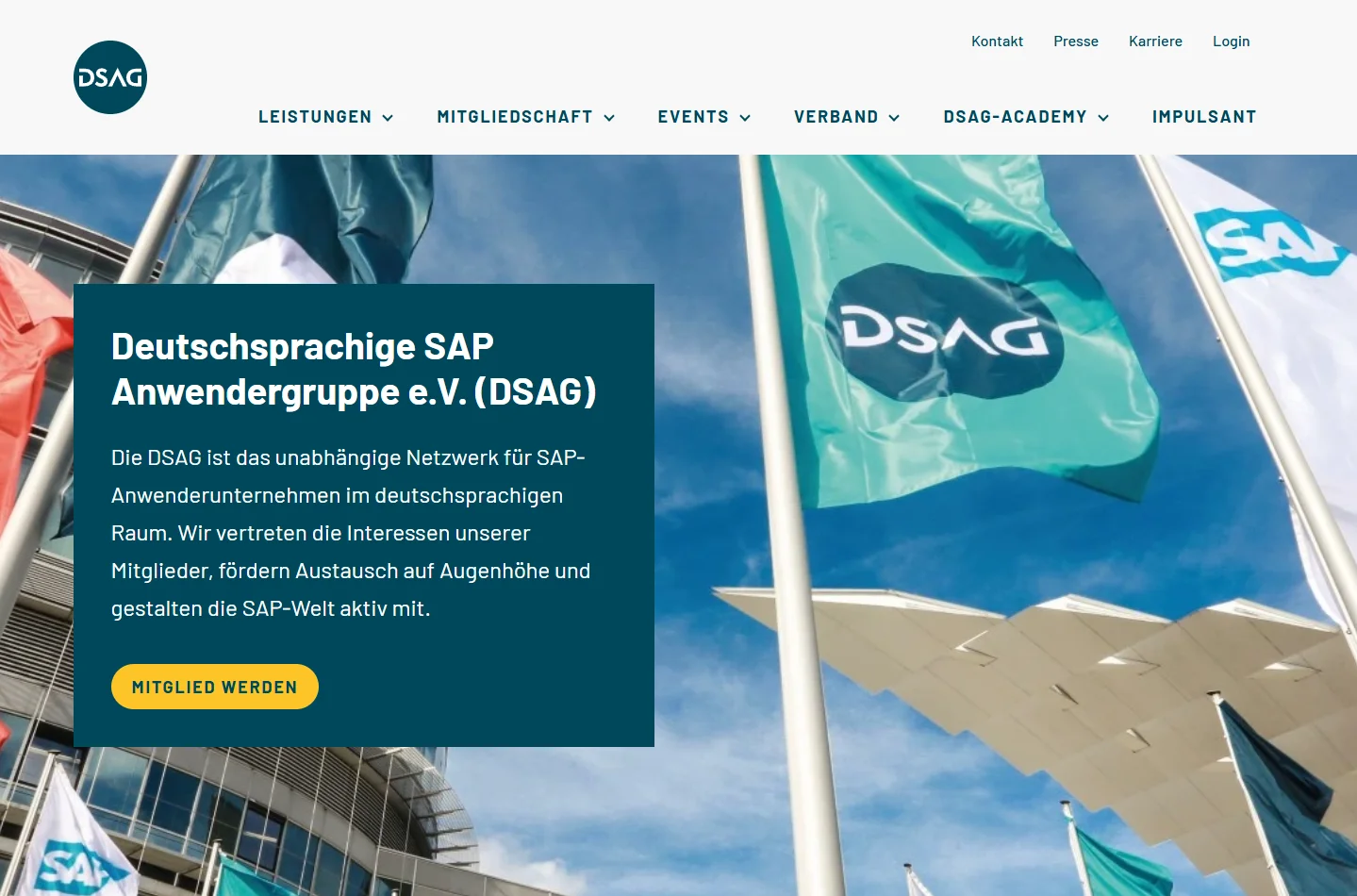
The DSAG Investment Report 2026 and the DSAG Technology Days in Hamburg show that SAP remains relevant for enterprise users across the DACH region – but budgets are being allocated more selectively, cloud models are under scrutiny, and AI is gaining traction slowly but has not yet reached broad adoption.
Rising IT budgets but increasingly selective decision-making: The German-speaking SAP User Group (DSAG) paints a clear picture of the SAP ecosystem in 2026. Investment decisions are driven less by strategic vision and more by concrete questions of cost-effectiveness, feasibility, and integration capability. S/4HANA continues to gain ground, on-premises deployment remains the preferred model, and artificial intelligence is making its way into organizations – mostly through non-SAP solutions. SAP is expected to deliver on transparency, flexibility, economically viable models, and realistic migration paths.
IT and SAP budgets continue to grow in 2026, but the share of companies increasing their budgets has declined compared to 2024. While 38% of surveyed DACH companies report a rise in total IT spend (vs. 43% in 2024), 24% report a decrease (vs. 18%). SAP-specific budgets are growing at 43% of companies (vs. 46%), while 28% report cuts (vs. 19%).
S/4HANA On-Premises leads ERP deployments for the first time at 56% (2024: 44%), surpassing legacy SAP ECC at 54% (2024: 68%). S/4HANA Private Cloud rose to 17% (from 11%), while the Public Cloud holds at 5%. For 2026 investments, 42% plan high or medium spending on S/4HANA On-Premises, 22% on Private Cloud, and only 6% on Public Cloud.
Nearly half of remaining SAP ECC users plan to migrate to S/4HANA by end of 2030, entering paid extended maintenance. Only 37% plan to migrate by end of 2027. Skills shortages, parallel transformation projects, and limited budgets are causing schedule delays even when higher maintenance costs result.
On AI adoption, 43% of companies have already implemented AI use cases, 51% have not. Among those active, 77% use non-SAP AI solutions in production, while only 3% rely on SAP’s own AI. Complex license models and highly customized system landscapes are cited as key barriers to broader SAP-based AI adoption. The DSAG calls for greater freedom of choice, transparency, and realistic migration paths.
At the DSAG Technology Days 2026 in Hamburg (March 17–18), attended by over 3,000 participants, AI, data management, and IT security formed the three central themes. DSAG Technology Board member Stefan Nogly stressed that AI must function as an orchestrated system with clear governance – not as a loose collection of use cases. SAP should increase the maturity of its AI products and simplify their adoption.
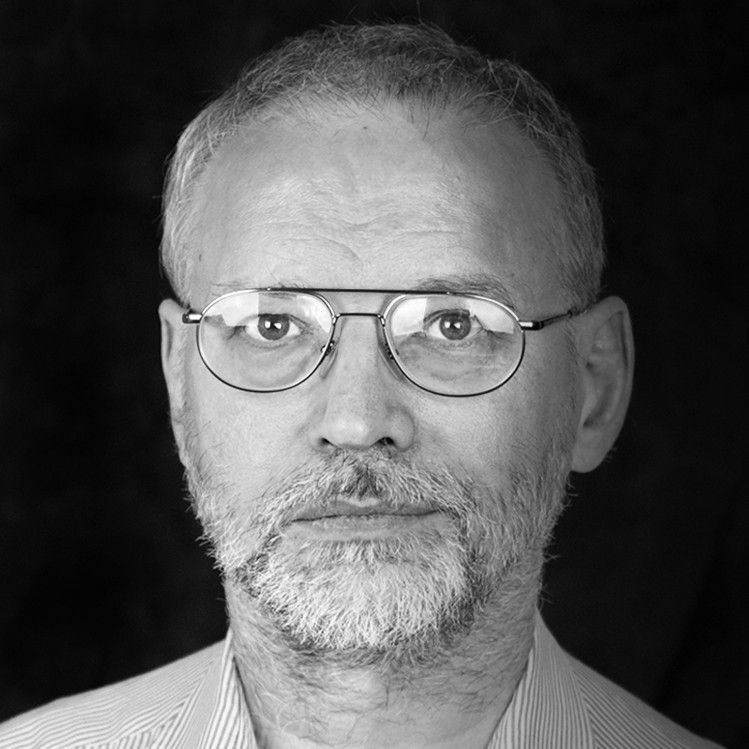
Dr. Jakob Jung is Editor-in-Chief of Security Storage and Channel Germany. He has been working in IT journalism for more than 20 years. His career includes Computer Reseller News, Heise Resale, Informationweek, Techtarget (storage and data center) and ChannelBiz. He also freelances for numerous IT publications, including Computerwoche, Channelpartner, IT-Business, Storage-Insider and ZDnet. His main topics are channel, storage, security, data center, ERP and CRM.
Contact via Mail: jakob.jung@security-storage-und-channel-germany.de