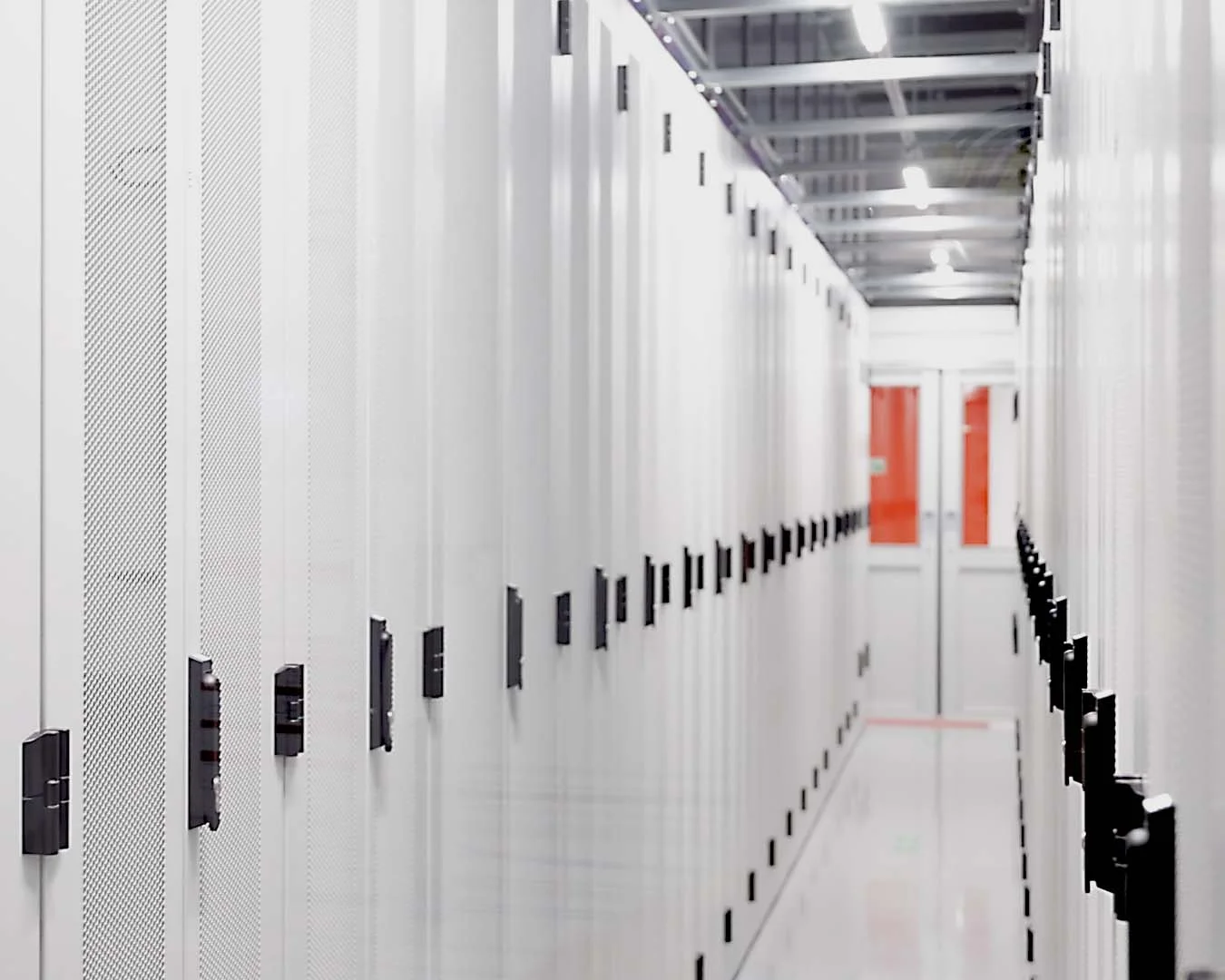
The German Federal Cabinet recently adopted the National Data Center Strategy. The goal: to at least double data center capacities by 2030, and to at least quadruple those dedicated to high-performance computing and artificial intelligence. The message is clear: anyone who wants to remain competitive in the global market needs a powerful digital infrastructure as its foundation.
Connected production, neo-cloud, AI applications, digital government services — each of these developments demands computing power, storage, and network connectivity on a scale that was unforeseeable just a few years ago. Behind every digital service stand physical data centers that must run around the clock.
Bitkom states it plainly: data centers form the indispensable backbone of digital infrastructure and are essential for digital sovereignty and for new key technologies.
At the same time, capacity in Germany is growing more slowly than demand, while other nations are massively expanding their infrastructure. Digital capability and economic competitiveness are interdependent. Those who fall behind in infrastructure lose value creation and business opportunities.
AI Is Changing Infrastructure Requirements
GPU-based AI workloads, model training, large language models, and e-government solutions require significantly higher power densities than traditional enterprise IT. Modern AI-capable data centers achieve rack densities far beyond those of conventional server rooms. This has direct implications for cooling concepts, power supply, and network design.
At the same time, AI enables more efficient operations: automated cooling control and predictive maintenance reduce energy consumption and downtime. Modern data centers today can achieve a PUE (Power Usage Effectiveness) value of below 1.3.
The National Data Center Strategy: Framework and Goals
The strategy is aimed at operators, investors, equipment suppliers, and the public sector. It is structured around three fields of action: the first, Energy and Sustainability, aims to make data centers an active part of the energy transition. The second, Location and Space, focuses on streamlining approval and planning procedures and designating preferred development zones. The third, Technology and Sovereignty, encompasses the development of European AI computing capacities and support for an AI gigafactory in Germany.
Today, the time from the first permit application to the commissioning of a new data center can sometimes span four to six years.
The data center strategy addresses this with acceleration measures. It strategically reinforces this framework through investment incentives and approaches for European AI computing infrastructure.
Its implementation is set to begin within the next twelve months and will be reviewed annually.
Colocation: A Future-Proof Alternative
For most companies, operating their own data center involves considerable effort: certifications, operational security, power supply, and specialized personnel. Colocation solves this problem: the company operates its own hardware in a professionally managed data center, renting floor space, power, and connectivity — without needing to maintain the infrastructure itself.
Key advantages:
- Scalability: Capacity can be expanded on short notice without initiating construction projects. IT growth remains plannable.
- Connectivity and Latency: Colocation sites feature multiple carrier connections and direct access to Internet Exchange Points, minimizing latency and maximizing bandwidth.
- Security: Certified operations under ISO 27001 and other standards, with physical access control, redundant power supply, and 24/7 monitoring. This level of security is difficult to achieve in internal server rooms.
- Full Data Sovereignty: Owning your hardware means complete control over data and access. No shared resources, no risk of unintended disclosure.
- Digital Sovereignty: Providers with a registered office in Germany and a European ownership structure are subject to European law, without third-party state access.
- Regional Proximity: Local providers know the regulatory requirements, network infrastructure, and business landscape of their region. Short response times and direct points of contact are hard to come by with global providers.
- Sustainability: Colocation data centers power their facilities with renewable energy, utilize waste heat for district heating networks, and employ modern cooling concepts — a measurable contribution to ESG goals.
There Is a Need to Catch Up
Bitkom states in its position paper: Germany must act now, before it is too late for a new capacity for innovation.
Falk Weinreich, CEO of colocation data center Portus Data Centers, agrees: “The new data center strategy from the German government is bold and an important step toward a competitive and digitally sovereign Europe. Portus Data Centers strongly supports this strategy and commits to continuing to invest in a secure, connected, and scalable German digital infrastructure.”
In Practice: Maximum Performance, Minimum Latency
One example of an edge colocation data center is the Portus Data Centers Group, with locations in Hamburg, Munich, and Luxembourg. The company offers carrier-neutral colocation with international connectivity. Data processing takes place in a decentralized manner, closer to the respective point of use, resulting in lower latency and data storage within the European legal framework, among other benefits.
Conclusion
Without powerful computing infrastructure, there is no digital economy and no future. That is the core message of the National Data Center Strategy. The goals for 2030 are ambitious, and their success depends on various factors, including accelerated permitting procedures, modern infrastructure, and a qualified workforce.
For companies looking to realign their IT infrastructure, local colocation data centers are a compelling choice: they combine technical performance with data sovereignty, regional proximity, and legal certainty within the European framework.

Carolina Heyder is a business analyst and moderator with extensive experience in the German and international IT market. She has worked for many years at renowned European trade publishers such as WEKA Fachmedien, Vogel IT Medien, Springer, and Aspencore. She creates content for both web and print media and is an expert in front of the microphone and camera. Thanks to her fluency in German, English, and Spanish, as well as her Chilean roots, she brings a global and intercultural perspective to topics such as cybersecurity, artificial intelligence, digital transformation, sustainability, and other key areas of the IT sector.