IO River has developed a DNS-based orchestration platform that separates edge infrastructure management from application services, targeting the growing fragility of single-CDN dependencies, as shown on IT Press Tour.
Every major content delivery network (CDN) has experienced at least one global outage lasting several hours in the past three years. For the companies that depend on these networks to serve content, run AI services, or process payments, the standard industry SLA of 99.9 percent — which permits up to 8.76 hours of downtime per year — increasingly fails to match operational expectations. IO River, a startup founded in 2022 and headquartered in Boston and Tel Aviv, is building a platform it calls Virtual Edge, designed to orchestrate traffic across multiple CDN providers simultaneously through DNS-level control, without inserting itself into the data path.
The CDN industry’s structural problem, as IO River’s co-founder and CEO Edward Tsinovoi described it on IT Press Tour, is that the sector remains organized around a 1990s model in which all internet traffic passes through a single edge provider. In that era, distributing static content through thousands of geographically dispersed servers was itself the innovation. Today, content has become dynamic, personalized, and AI-generated at scale, yet the infrastructure model has not fundamentally changed.
Tsinovoi, who previously led core platform development at Akamai for several years — including edge computing technologies and performance infrastructure — left to co-found IO River with Michael Hakimi, the company’s CTO, who also comes from Akamai and Rafael Advanced Defense Systems. The company is backed by S Capital (the former Sequoia Israel branch), Venture Guides, New Era, and Pags Group, and has raised a total of $25 million, including a $20 million round completed in early 2026. Investors include industry figures such as Ash Kulkarni, CEO of Elastic and former GM at Akamai, and Ronni Zehavi, co-founder of Cotendo and HiBob.
The core argument IO River makes to prospective customers is built around documented outage data. Its presentation at IT Press Tour #68 in Boston in June 2026 cited eight major CDN outages between June 2023 and February 2026 across Cloudflare, AWS CloudFront, Akamai, Google Cloud CDN, and Microsoft FrontDoor — ranging in duration from two to twenty-five hours. The December 2025 Cloudflare incident, which lasted twenty-five hours, is the most recent extended example. IO River estimates that a single major CDN outage, representing a few hours of disruption, has caused more than ten billion dollars in aggregate damage to affected customers — an amount exceeding the lifetime revenues of the vendors responsible.
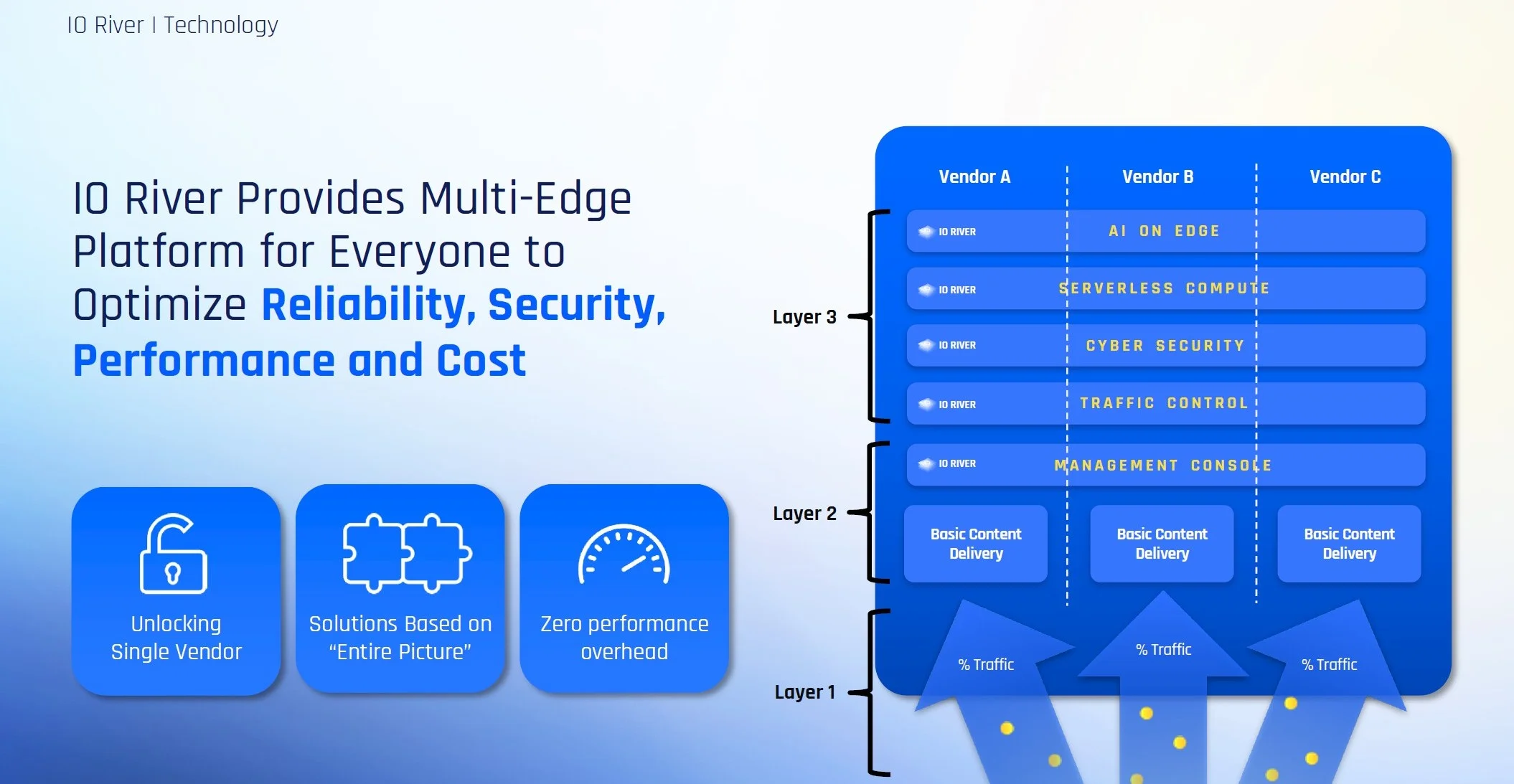
The company’s proposed solution is not a new CDN, nor a traditional multi-CDN load balancer. IO River describes its offering as a Virtual Edge platform that operates at the DNS layer. When an end user’s browser or video player initiates a DNS resolution request, IO River controls the response through CNAME routing, directing traffic to one of the underlying CDN providers based on real-time signals. The company uses AWS Route 53 and IBM NS1 as its DNS partners for redundancy. Critically, IO River is not inline: it does not sit between the end user and the CDN. If the IO River control plane itself were to fail, traffic would continue flowing along its last-resolved path. The company offers a five-nines SLA for its own platform availability, though its CEO acknowledges that in a simultaneous failure scenario — IO River down at the same moment as an active CDN outage — traffic rerouting would not occur.
The platform is structured in three layers. Layer 1 handles raw traffic distribution across CDN providers. Layer 2 provides a management console. Layer 3 — the differentiating tier — hosts application services including AI on Edge, serverless compute, cybersecurity, and traffic control. These Layer 3 services operate via IO River’s own implementation rather than being sourced from individual CDN providers, breaking what Tsinovoi describes as the “traditional bundle” in which a CDN customer can only use the WAF, bot management, or image optimization that the CDN itself provides.
On the security side, IO River has announced a partnership with Check Point Software, bringing Check Point’s AppSec capabilities — including an AI-based WAF that learns customer traffic patterns and detects zero-day vulnerabilities — to the platform’s edge layer. This allows customers working with multiple CDNs to maintain consistent security policies across all providers, addressing what IO River calls “policy drift” — the risk that security rules diverge between CDN environments when traffic shifts during a failover.
The pricing model comprises three components: a platform service fee based on configuration size, traffic fees for customers who choose to route their CDN contracts through IO River rather than maintaining existing CDN relationships directly, and application service fees based on requests and other metrics.
IO River’s go-to-market approach is primarily direct in North America, supplemented by reseller and system integrator partnerships in Europe. In Germany, the company works with Equitel; in France with GNN. The company has approximately 50 customers across verticals including OTT media, publishers, gaming, edtech, e-commerce, and hospitality. Named customers include Miniz Media, a UK-based sports content provider, Nexen, and hotel group Core Hotels. For the 2026 FIFA World Cup, IO River is working with a broadcaster operating in a German-language market — the company declined to name the specific organization — to provide multi-CDN capacity management for live match delivery.
The competitive landscape, in IO River’s assessment, consists largely of large enterprises that have built internal multi-CDN orchestration teams — Tsinovoi cited PayPal, Amazon, Walmart, and eBay as companies that manage this complexity with dedicated engineering headcount — and a small number of startups attempting comparable approaches. Gartner has recommended IO River as a multi-edge solution. The company holds multiple registered patents in the United States, though Tsinovoi notes that patents provide limited competitive protection in the infrastructure industry.
Looking toward the next 12 to 18 months, IO River’s roadmap centers on AI inference at the edge. Tsinovoi draws a parallel with how CDNs originally distributed static content closer to end users and later enabled dynamic compute at the edge: AI inference, he argues, will follow the same trajectory, with large model inference remaining centralized while latency-sensitive or lightweight inference models migrate to edge nodes. This, he suggests, makes resilience and intelligent traffic management at the edge increasingly critical infrastructure for any organization building AI-dependent services.
Dr. Jakob Jung is Editor-in-Chief of Security Storage and Channel Germany. He has been working in IT journalism for more than 20 years. His career includes Computer Reseller News, Heise Resale, Informationweek, Techtarget (storage and data center) and ChannelBiz. He also freelances for numerous IT publications, including Computerwoche, Channelpartner, IT-Business, Storage-Insider and ZDnet. His main topics are channel, storage, security, data center, ERP and CRM.
Contact via Mail: jakob.jung@security-storage-und-channel-germany.de