As enterprise IT infrastructure buckles under unprecedented complexity, newly crowned Gartner Magic Quadrant Leader NinjaOne takes center stage at Berlin Messe to prove why unified automation is the ultimate antidote to innovation-killing legacy technical debt.
The collision between massive endpoint proliferation and stagnant operational resources has reached a critical tipping point. At GITEX Europe 2026, hosted at the Berlin Messe, unified IT operations pioneer NinjaOne is laying down a definitive marker for the future of the industry. Backed by its fresh debut as a “Leader” in the 2026 Gartner Magic Quadrant for Endpoint Management Tools and a massive $500 million Series C funding injection plus a secondary funding round of $400 million, which catapulted the company’s valuation to $12.3 billion, the Austin-headquartered firm has transformed Hall 2.2 into a high-octane showcase of modern digital infrastructure. Anchoring this presence is Tom Molden, NinjaOne’s CIO of Global Executive Engagement, whose central message to international enterprise leaders is uncompromising: legacy technology is no longer just an operational hassle—it is the ultimate brake pedal for corporate innovation.
The Cost of Fragmentation in a Hybrid World
Modern IT environments are operating under severe duress. According to data from industry analyst firm IDC, nearly two-thirds of organizations worldwide struggle with the inefficiencies of managing multiple disconnected single-purpose tools. This fragmentation forces technicians to waste thousands of hours manually balancing separate solutions for patching, software deployment, remote monitoring, and backups. In an era dominated by diverse hybrid work styles and evolving cyber threats, these visibility gaps compromise compliance frameworks and leave networks exposed to critical vulnerabilities.
NinjaOne’s cloud-native, multi-tenant architectural approach addresses this complexity head-on by consolidating disparate workflows into a single agent, console, and real-time data model. The operational impact is severe enough that customers routinely replace four or more legacy infrastructure products with the platform, eliminating technical debt while driving profound cost-efficiency across global enterprise operations.
Accelerating Innovation from the Show Floor
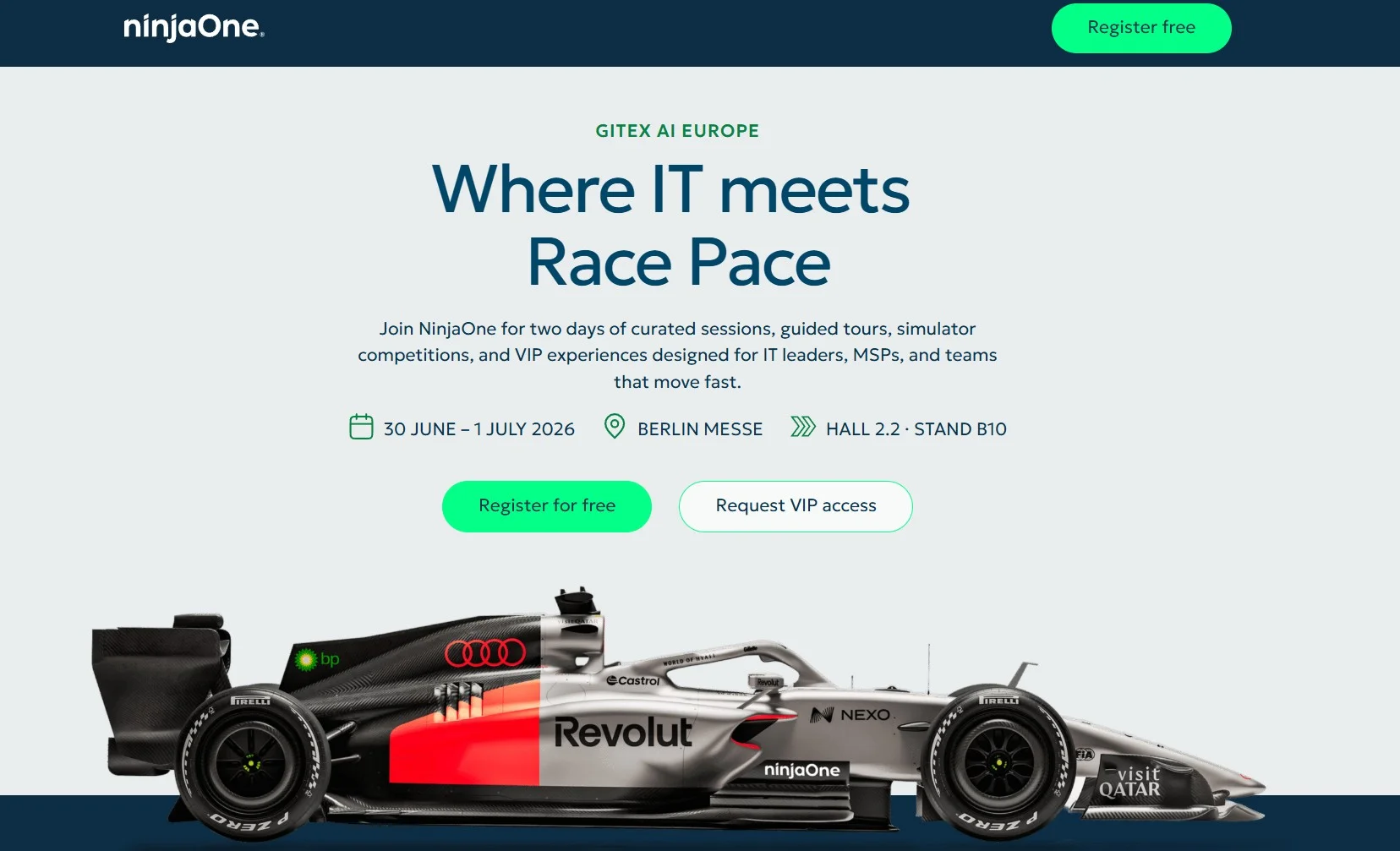
At GITEX Europe, the concept of operational velocity is manifested through NinjaOne’s official partnership with the Audi Revolut F1 Team. The center of the exhibition space features the “Racing CyBAR,” an immersive dome experience complete with professional racing simulator competitions where IT professionals vie for premium prizes worth up to €2,500 and signed Formula 1 merchandise.
Yet, beneath the high-speed branding lies a deeper architectural narrative. “IT teams simply do not have the luxury of time to manage fragmented tools and wrestle with legacy technological constraints,” explains Rahul Hirani, Chief Product Officer at NinjaOne. The company’s booth sessions focus heavily on bridging this gap, showcasing next-generation capabilities designed to shift enterprise management from a reactive posture to an autonomous, proactive model.
A key highlight of the event is the showcase of NinjaOne’s Patch Intelligence AI. This system connects AI-generated expertise with live vulnerability data and automated patching workflows, enabling IT teams to assess, prioritize, and remediate systemic software flaws instantly. By combining these autonomous patching protocols with zero-touch endpoint deployment and cross-functional self-healing scripts, the platform successfully handles routine maintenance without human intervention, liberating technicians to execute strategic digital transformation initiatives.
A Validated Global Trajectory
NinjaOne’s expansion into GITEX Europe highlights a long-term commitment to international markets. “We are a top sponsor at GITEX,” states CIO Tom Molden, emphasizing the strategic importance of the European landscape. “We are expanding globally and have maintained a strong German presence for eight consecutive years.”
This regional footprint is backed by surging market momentum. The platform now supports more than 35,000 organizations across 140 countries, spanning heavily regulated sectors like healthcare, finance, public administration, and advanced manufacturing. Furthermore, NinjaOne recently achieved stringent compliance certifications including FedRAMP Moderate, GovRAMP, and Texas-RAMP, making its modern endpoint architecture accessible to strict public sector environments.
This rapid enterprise adoption is heavily reinforced by user validation. In tandem with its top-tier Gartner Magic Quadrant positioning, NinjaOne was recognized as a Strong Performer in the Gartner Peer Insights “Voice of the Customer” report, securing the highest customer “willingness to recommend” rate at 96% based on long-term reviewer sentiment.
Gartner: “NinjaOne delivers a strong customer experience through dedicated customer success managers focused on value over sales, proactive account health tracking, and self-service resources such as certifications and technical documentation. Analysis of Gartner Peer Insights and other external customer experience measurements reflects generally positive customer sentiment, especially with ease of use and time to value.”
The Enterprise Roadmap Ahead
While legacy infrastructure vendors struggle to adapt their architectures for cloud environments, NinjaOne is deploying its capital reserves to deepen its competitive moat. The company’s immediate development roadmap prioritizes the expansion of advanced autonomous orchestration, broader multi-operating system compliance tracking, and deeper ecosystem integrations across mobile device management (MDM) and cloud asset portfolios.
For the thousands of IT leaders and managed service providers (MSPs) gathered in Berlin, the path forward is clear. To match the velocity of modern commercial markets, organizations must strip away the friction of fractured administration. By pairing extreme operational speed with rigorous automation, NinjaOne is proving that when enterprise infrastructure moves fast, innovation naturally follows.

Dr. Jakob Jung is Editor-in-Chief of Security Storage and Channel Germany. He has been working in IT journalism for more than 20 years. His career includes Computer Reseller News, Heise Resale, Informationweek, Techtarget (storage and data center) and ChannelBiz. He also freelances for numerous IT publications, including Computerwoche, Channelpartner, IT-Business, Storage-Insider and ZDnet. His main topics are channel, storage, security, data center, ERP and CRM.
Contact via Mail: jakob.jung@security-storage-und-channel-germany.de