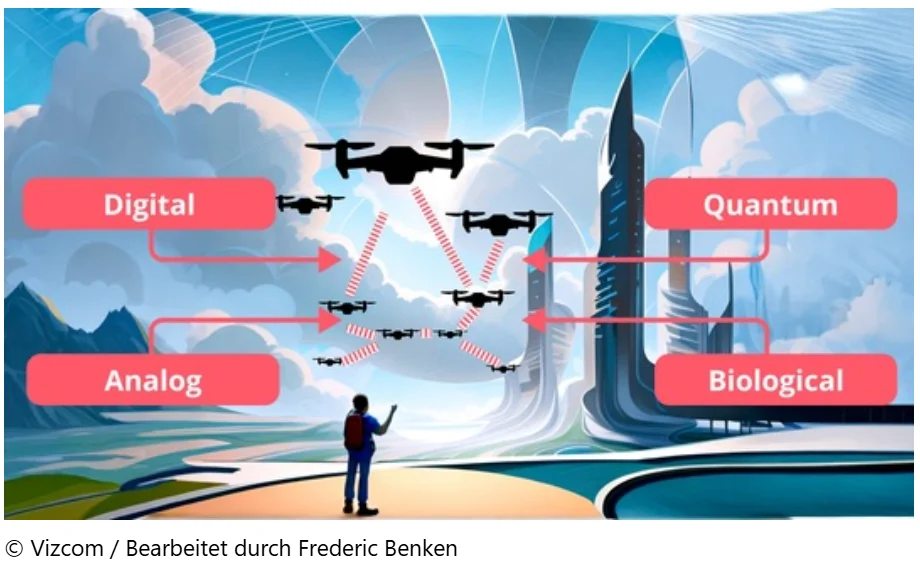
The joint research initiative CommUnity, launched by the Technical University of Dresden (TUD) and the Technical University of Munich (TUM), aims to build the communication systems of tomorrow. Backed by €15 million from Germany’s Federal Ministry for Research, Technology and Space, the project combines 6G, artificial intelligence, quantum communication, and molecular communication — with societal participation at its core.
Research as a Social Responsibility
The starting line has been crossed. With CommUnity, TU Dresden and TU Munich have launched a collaborative research project that reaches far beyond conventional engineering. The name says it all: the initiative treats communication technology not as an end in itself, but as societal infrastructure. Funded by the German Federal Ministry for Research, Technology and Space (BMFTR) with €15 million, the project runs through December 2029.
A Toolbox for the Communications of Tomorrow
At its core, CommUnity develops a flexible, modular toolbox of interoperable technologies, architectures, and design principles. The scope of research is wide: AI-powered, energy-efficient 6G mobile networks form the backbone, complemented by quantum communication and the emerging field of molecular communication. What distinguishes CommUnity is its integrative approach — these building blocks are designed not to exist in isolation, but to function as a coherent system that can flexibly adapt to evolving societal needs.
„CommUnity stands for Shared Prosperity — technologies that don’t just enable cutting-edge applications, but benefit society at large. Mobile communications showed how infrastructure can make prosperity broadly accessible. CommUnity takes this idea further, developing AI-integrated communication technologies that are open, efficient, and trustworthy.“ — Professor Frank Fitzek, Project Coordinator at TUD
Fitzek’s statement strikes at a central tension in today’s AI landscape: while mobile networks have historically given broad populations access to communication, the benefits of modern AI systems increasingly concentrate among a handful of providers and users. CommUnity sets out to address this imbalance directly.
Disruptive Research Over Incremental Progress
The project leadership is unambiguous about its ambition: CommUnity deliberately ventures into research areas that industry still considers too risky to pursue. By establishing open testbeds and demonstrators, the project creates infrastructure accessible to large corporations and startups alike — enabling companies to experiment with emerging technologies long before market readiness.
„Open testbeds allow us to create an ecosystem bridging fundamental research and industrial value creation, enabling long-term innovation. Some of these technologies will be decisive for the competitiveness of entire industries in Germany.“ — Professor Holger Boche, Project Coordinator at TUM
Boche’s words highlight the project’s strategic dimension: CommUnity explicitly positions itself as a contribution to securing Germany’s technological leadership, at a time when international competition in communications — particularly from Asia — is intensifying sharply.
Technological Sovereignty as Political Agenda
CommUnity fits seamlessly into current industrial policy debates. Technological sovereignty — the ability to independently develop and control critical infrastructure — has become a central concept in European technology policy. The project provides concrete scientific foundations for this goal: open architectures, trustworthy AI integration, and broad societal participation are not only research objectives but also responses to geopolitical challenges. With a timeline extending to 2029 and a clearly practice-oriented approach, CommUnity has the potential to reshape Europe’s communications landscape.
Dr. Jakob Jung is Editor-in-Chief of Security Storage and Channel Germany. He has been working in IT journalism for more than 20 years. His career includes Computer Reseller News, Heise Resale, Informationweek, Techtarget (storage and data center) and ChannelBiz. He also freelances for numerous IT publications, including Computerwoche, Channelpartner, IT-Business, Storage-Insider and ZDnet. His main topics are channel, storage, security, data center, ERP and CRM.
Contact via Mail: jakob.jung@security-storage-und-channel-germany.de