Artificial intelligence is no longer an emerging technology—it is a central pillar of business strategy. Yet as adoption accelerates across industries, a new challenge has emerged: turning fragmented initiatives into coordinated, scalable transformation.
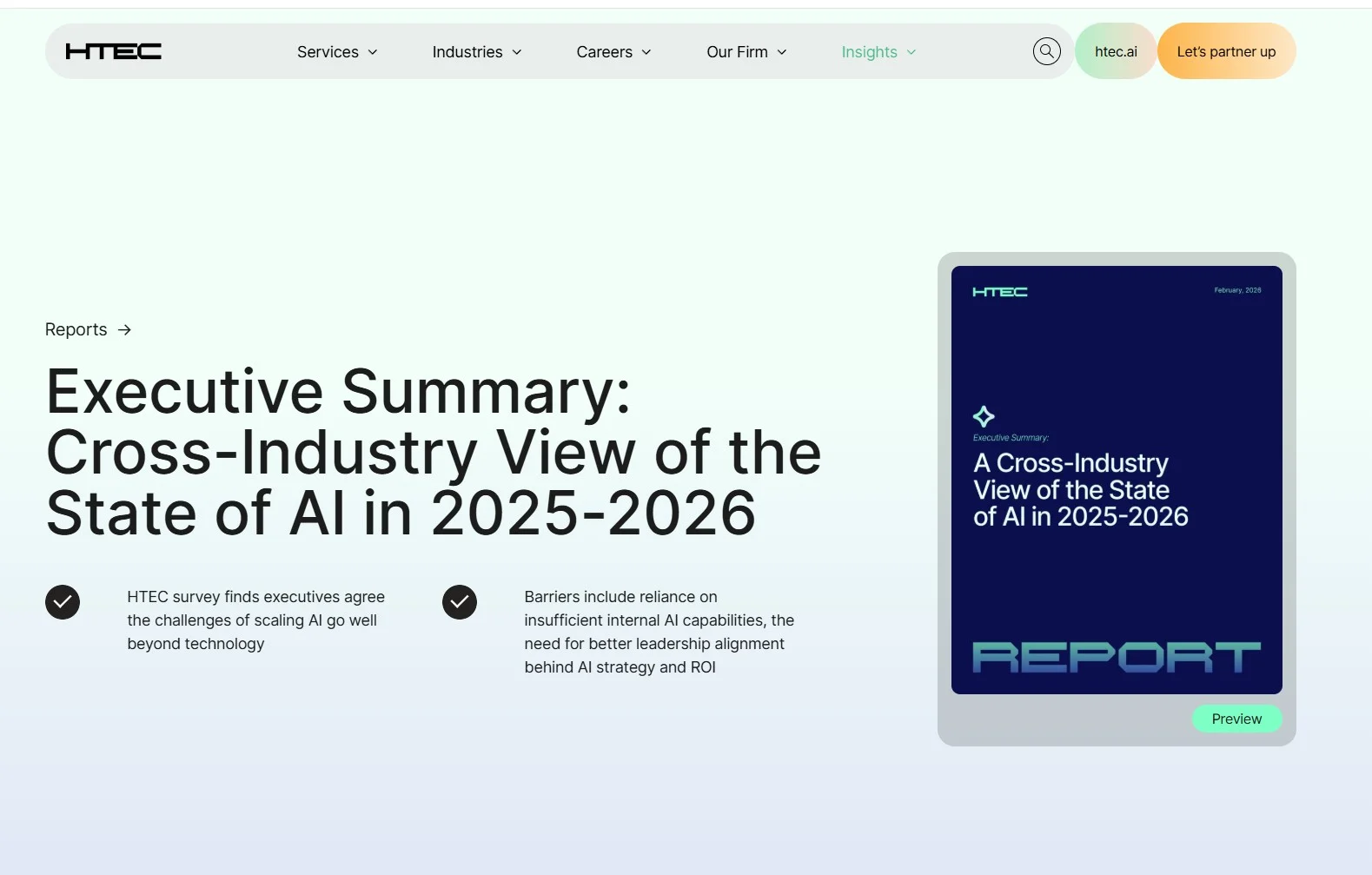
Artificial intelligence has entered a new phase of maturity. Across industries, organizations have largely moved beyond experimentation, with nearly all reporting some level of deployment. However, widespread adoption has not translated into consistent, enterprise-wide impact. The central issue is no longer whether companies use AI, but how effectively they integrate it into core operations, according to a study by HTEC titled “A Cross-Industry View of the State of AI in 2025–2026”.
The global survey of 1,529 C-suite executives highlights a common pattern. While 45% of organizations report that AI is fully embedded across multiple functions, a larger share continues to operate in fragmented or partial deployment stages. This gap between adoption and integration reveals a structural challenge: scaling isolated successes into cohesive business value.
The underlying constraints are both technical and organizational. Executives identify integration into existing systems as the most significant barrier, closely followed by misalignment within leadership teams and uncertainty about prioritization. These issues suggest that AI transformation is less about technological capability and more about coordination across strategy, governance, and execution.
At the same time, leadership confidence in organizational performance remains high. Most executives rate their companies positively across innovation, resilience, and digital infrastructure. This indicates that the friction in AI transformation does not stem from weak foundations, but from the complexity of embedding AI across interconnected systems and workflows.
Skills shortages further complicate progress. Gaps in data engineering, machine learning, cybersecurity, and DevOps are already producing measurable business impacts, including higher costs, slower innovation cycles, and delayed market entry. Nearly all surveyed organizations report some form of capability deficit, underscoring that talent constraints are not isolated but systemic.
Leadership readiness emerges as a decisive factor. While alignment on AI strategy is generally strong, AI literacy varies significantly. Many executive teams understand the strategic importance of AI but lack the depth required to guide large-scale implementation. As a result, organizations can often initiate projects effectively but struggle to scale them reliably.
The growing importance of edge AI illustrates the next stage of this evolution. Organizations increasingly seek to process data closer to its source, driven by requirements for speed, resilience, and data governance. Confidence in deploying edge AI is high, yet successful implementation depends on investments in infrastructure, data architecture, and workforce capabilities.
Despite these challenges, the urgency to act is clear. Executives estimate that failing to capitalize on AI opportunities could set their organizations back by nearly two years. Most are therefore targeting short timelines—typically one to three years—to validate use cases, deploy scalable systems, and develop new revenue streams.
Overall, the findings point to a shift in how AI should be understood. It is no longer a standalone technology initiative but a cross-functional transformation requiring alignment at every level of the organization. Companies that succeed will be those that move beyond pilots, integrate AI into end-to-end processes, and build the capabilities needed to sustain long-term value creation.

Dr. Jakob Jung is Editor-in-Chief of Security Storage and Channel Germany. He has been working in IT journalism for more than 20 years. His career includes Computer Reseller News, Heise Resale, Informationweek, Techtarget (storage and data center) and ChannelBiz. He also freelances for numerous IT publications, including Computerwoche, Channelpartner, IT-Business, Storage-Insider and ZDnet. His main topics are channel, storage, security, data center, ERP and CRM.
Contact via Mail: jakob.jung@security-storage-und-channel-germany.de