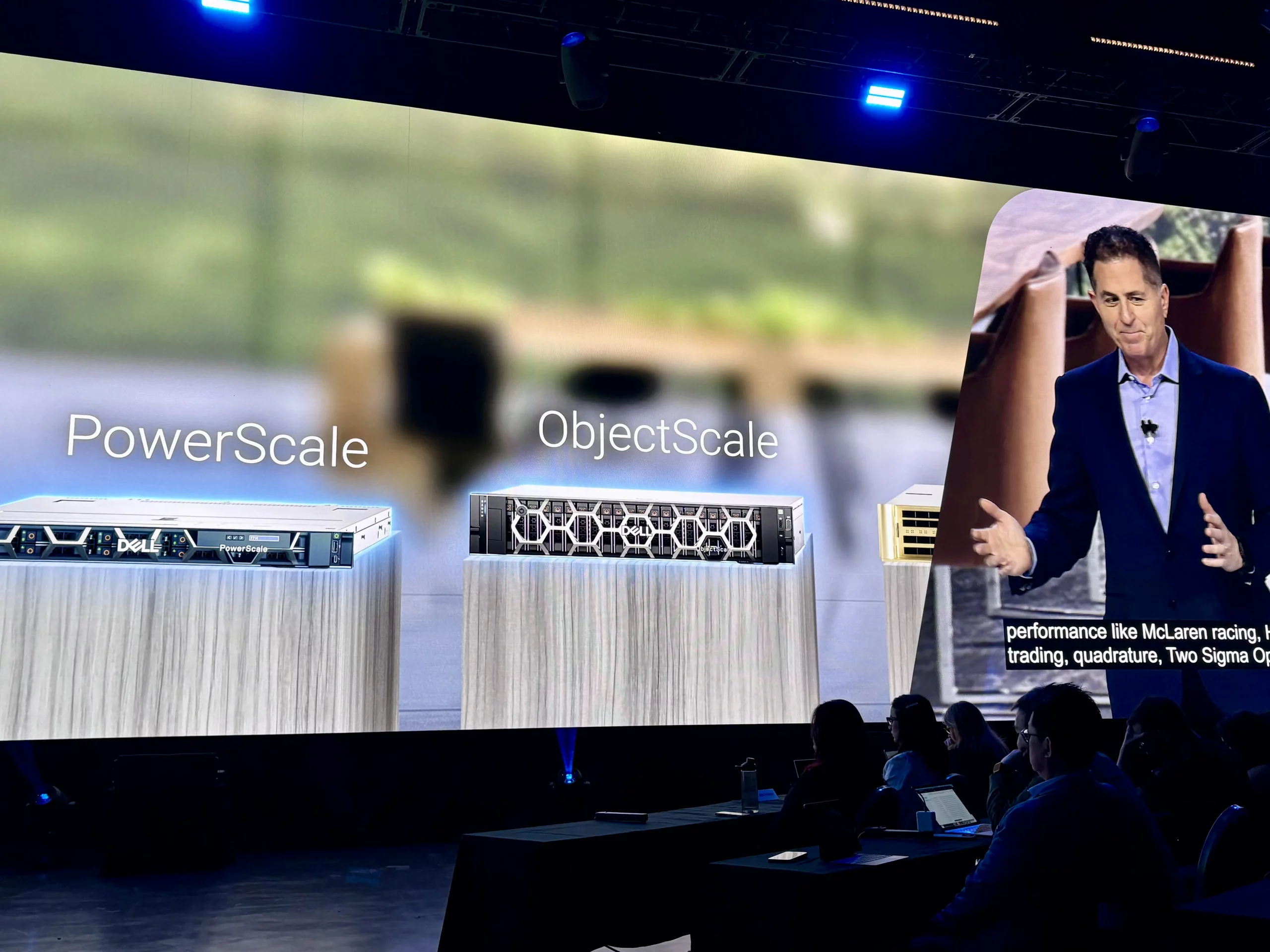
At Dell Technologies World 2026 in Las Vegas, Dell is unveiling PowerStore Elite, its flagship enterprise storage solution: triple the performance, up to 5.8 petabytes of effective capacity in a 3U form factor, contractually guaranteed 6:1 data reduction, and built-in AI-based ransomware detection. The portfolio is complemented by eleven new PowerEdge servers and an open automation platform.
The era of AI experimentation is over. Anyone who listened to CEO and founder Michael Dell’s opening remarks at Dell Technologies World 2026 in Las Vegas understood the message immediately: enterprises are asking for measurable value today, not additional proof-of-concepts. “Intelligent solutions are already everywhere. They are not about to arrive—they are here now,” Dell told thousands of industry visitors. The company responds to this shift with a coordinated product offensive spanning storage, servers, cybersecurity and automation under one unifying theme: AI infrastructure that is production-ready.
PowerStore Elite: Enterprise Storage Rethought
At the centre of the announcements stands the completely redesigned enterprise storage platform PowerStore Elite. The three new models—1500, 5500 and 9500—consolidate block, file, VM and container workloads on a single platform, delivering three times the read/write performance and three times the storage density of the previous generation.
The capacity density is technically notable: up to 5.8 petabytes of effective capacity in a single 3U chassis accommodating up to 40 drives. The foundation is non-proprietary, industry-standard low-profile E3 NVMe flash. Dell justifies the decision against proprietary flash types by aiming to give customers a broader choice of suppliers, more competitive pricing, and independence from strained supply chains.
A contractually guaranteed 6:1 data reduction ratio completes the offering. Guarantees of this kind are not unprecedented in the storage industry, but they significantly improve planning certainty for procurement decision-makers. Connectivity is provided by up to 40 network ports per appliance with 64 Gb Fibre Channel and 200/400 GbE. General availability is scheduled for Q2 2026.
Particularly noteworthy is the architectural decision for modular components: drives, controllers and network interfaces can each be swapped or expanded independently during live operation—without data migration, without planned downtime. Dell markets this as “Non-Disruptive Modernization.” For operators of large storage environments who have historically classified upgrades as project risk, this approach has the potential to substantially reduce planning overhead.
AI-powered AIOps functions are stated to reduce manual storage administration effort by up to 95 per cent and resolve issues in large environments up to ten times faster than conventional approaches. Dell bases these figures on its own customer survey.
PowerEdge Generation 18: Higher Compute, Broader Cooling Options
Eleven new server models for air- and liquid-cooled data centres extend the announcements. PowerEdge Generation 18 promises up to 70 per cent more compute performance in the same footprint, plus a 13:1 consolidation ratio compared to its predecessor.
Dell positions the PowerEdge M9825 as the platform for AI and HPC workloads: a liquid-cooled blade server based on sixth-generation AMD EPYC processors, delivered pre-configured in the IR7000 rack. For large-scale PCIe-based AI inference, the air-cooled PowerEdge XE5845 and XE7845 systems support next-generation GPUs—availability planned for Q1 2027.
In the CPU segment, the PowerEdge R9810 stands out: the single-socket 2U server is based on Intel’s upcoming “Diamond Rapids” generation and offers double the memory bandwidth, larger caches and up to 50 per cent more cores. For conventional enterprise workloads, the R9825 and R9815 with AMD EPYC 6 and up to 256 cores are available.
Cyber Detect: Ransomware Detection at the Byte Level
On stage, Michael Dell explicitly warned against losing control over data, cost, security and intellectual property. With “Dell Cyber Detect,” the company addresses the persistently elevated ransomware threat landscape. The AI-based solution for PowerStore and PowerMax analyses data at the byte level and has been trained on thousands of known ransomware variants. Dell states a target detection rate of 99.99 per cent.
The declared goal: identify compromised data early and preserve a last clean copy for recovery before encryption or exfiltration is completed. Cyber Detect for PowerStore arrives in Q3 2026, the PowerMax version in the second half of 2026. Embedding detection directly in the storage platform—without a separate security tool or additional latency—represents a conceptually different approach from classical backup-based ransomware detection.
PowerProtect One complements the picture by bundling data protection, security and recovery under a single management interface, combining PowerProtect Data Manager with PowerProtect Data Domain and supporting third-party integrations. Dell estimates a reduction in management overhead of up to 50 per cent compared to isolated point solutions.
Automation: Open Interfaces Instead of Silos
The Dell Automation Platform uses AI-driven automation for infrastructure management and telemetry evaluation. With Automation Studio, organisations can build their own workflows for compute, storage and networking via open interfaces. Dell Private Cloud supports VMware Cloud Foundation, Microsoft Azure Local and, in future, Nutanix AHV in combination with PowerStore—with compute and storage resources scaling independently. The commitment to open APIs and multi-hypervisor support signals that Dell is betting on interoperability rather than lock-in through proprietary interfaces.
Assessment
Dell Technologies World 2026 presents a coherent picture: the company is positioning AI infrastructure not as a future promise but as a deliverable present. PowerStore Elite, the integrated security capabilities and the new PowerEdge generation address real operational requirements—high density, non-disruptive modernisation, protection without an add-on tool.
Three aspects merit particular attention: the 5.8 petabyte storage density in 3U, the live, non-disruptive upgrade capability, and the AI-based threat detection embedded directly in the storage layer. Whether the stated performance figures and detection rates hold up in heterogeneous production environments can only be assessed after broad field validation. The direction is clear—the proof will come in practice.

Carolina Heyder is a business analyst and moderator with extensive experience in the German and international IT market. She has worked for many years at renowned European trade publishers such as WEKA Fachmedien, Vogel IT Medien, Springer, and Aspencore. She creates content for both web and print media and is an expert in front of the microphone and camera. Thanks to her fluency in German, English, and Spanish, as well as her Chilean roots, she brings a global and intercultural perspective to topics such as cybersecurity, artificial intelligence, digital transformation, sustainability, and other key areas of the IT sector.