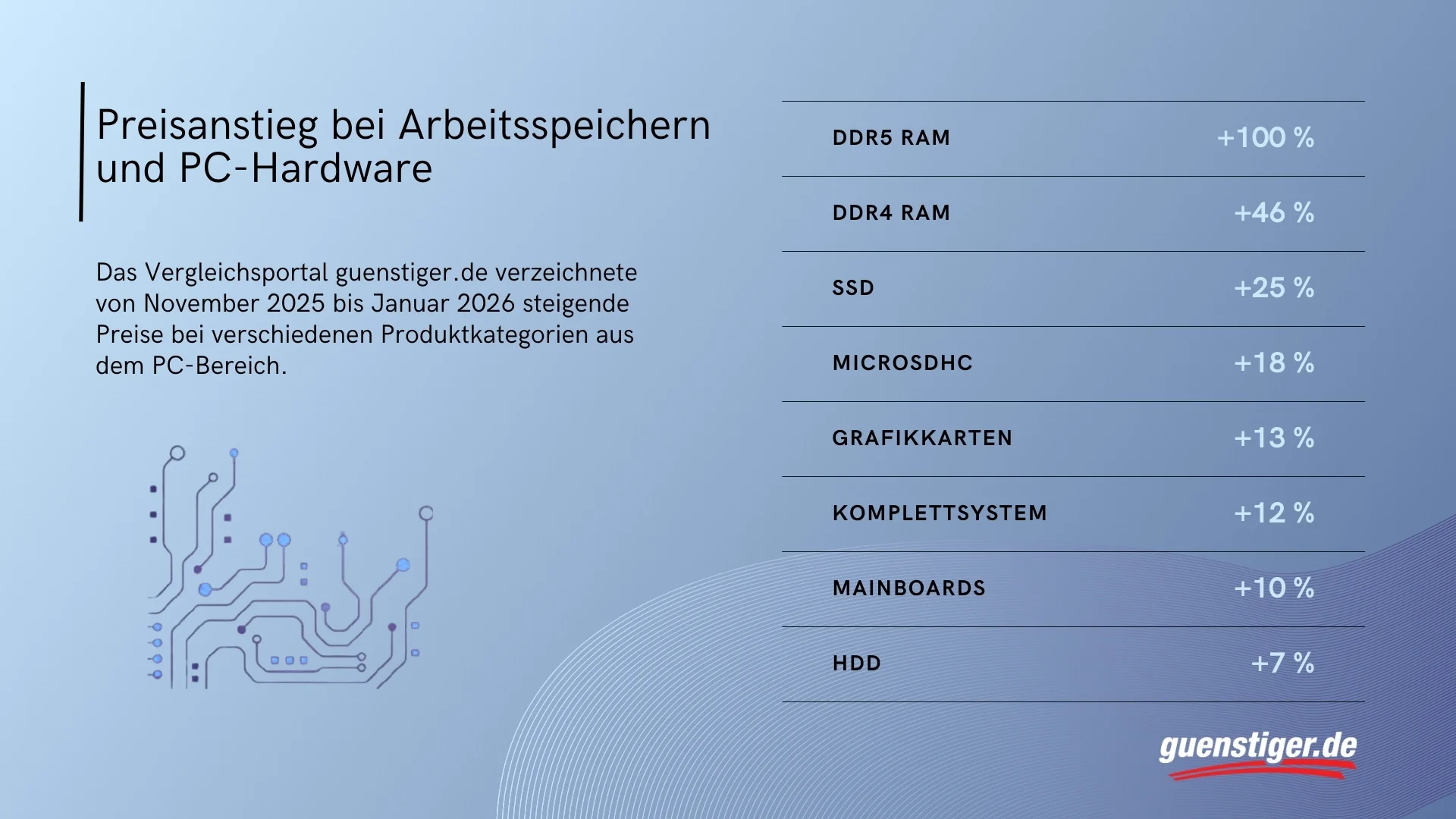
Between November 2025 and January 2026, the price of DDR5 RAM doubled. DDR4, graphics cards, SSDs, and motherboards have also become significantly more expensive.
Prices for memory are rising at a pace that even surprises industry observers. According to an analysis by the price comparison portal guenstiger.de, the average price of DDR5 RAM doubled between November 2025 and January 2026. This analysis is based on the price changes of over 28,000 products and is calculated using the lowest daily price from more than 2,000 online retailers.
This price increase affects more than just the latest memory generation. DDR4 RAM became 46 percent more expensive during the same period. Even DDR3 modules, considered obsolete for years, have increased in price by 28 percent — indicating widespread demand across all market segments.
Graphics cards, SSDs, motherboards
The effects are not limited to the storage market. On average, SSDs increased by 25 percent during the observation period, while traditional hard drives (HDDs) increased by 7 percent. MicroSDHC cards increased in price by an average of 18 percent. Graphics cards now cost 13 percent more; complete systems, 12 percent more; and motherboards, 10 percent more.
Notably: Mobile devices, such as notebooks, tablets, smartphones, and gaming consoles, have shown hardly any measurable price changes so far. These categories are apparently better buffered in the short term due to longer supply chains and inventories.
AI data centers are displacing the end consumer market.
This development is due to changes in the supply. The rapidly growing demand for high-performance memory for AI applications has led many manufacturers to focus more of their production capacity on data center products. This leaves less capacity for DDR5 modules and similar consumer products, even though demand remains consistently high.
Torben Mallwitz, CTO of guenstiger.de, explains the connection: “AI data centers consume a large portion of global memory chip production, which leads to less capacity remaining for consumer products like DDR5 modules and drives up prices.”
Currently, no short-term relief is expected. The price curve indicates that further increases are likely in the coming weeks and months.
What does this mean for buyers?
Those looking to build or upgrade a PC will face higher expenses than they would have at the end of 2025. Since there is no end in sight to this price increase, it is advisable not to postpone planned purchases any further. Price comparisons help find the cheapest offer at the time.

Dr. Jakob Jung is Editor-in-Chief of Security Storage and Channel Germany. He has been working in IT journalism for more than 20 years. His career includes Computer Reseller News, Heise Resale, Informationweek, Techtarget (storage and data center) and ChannelBiz. He also freelances for numerous IT publications, including Computerwoche, Channelpartner, IT-Business, Storage-Insider and ZDnet. His main topics are channel, storage, security, data center, ERP and CRM.
Contact via Mail: jakob.jung@security-storage-und-channel-germany.de