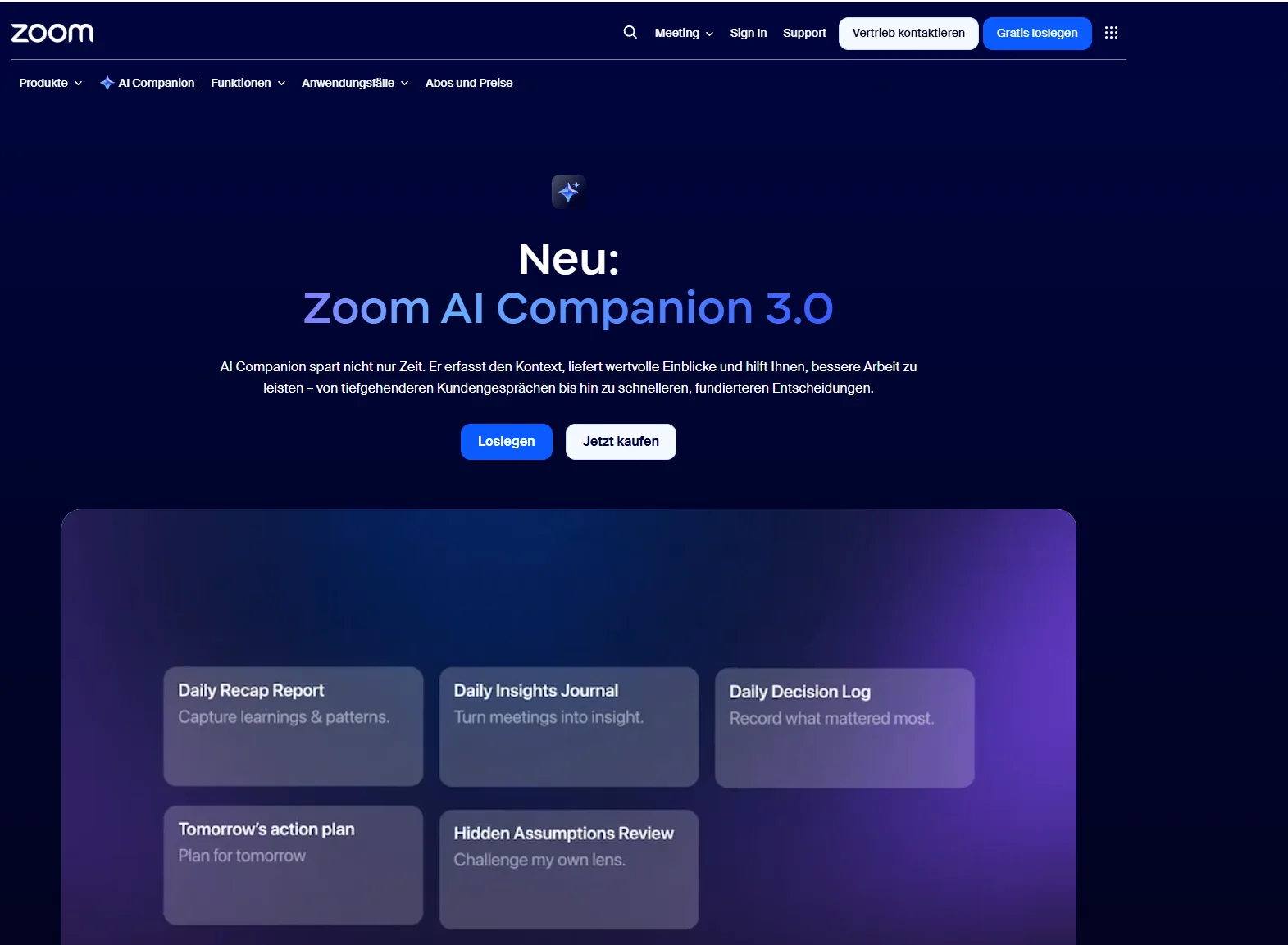
Zoom is expanding its AI Companion with agentic functions that will independently take over routine tasks.
In many companies, digital collaboration has organically grown over the years. For meetings, messaging, telephony, project work, and customer communication, new applications were gradually added. What initially seemed pragmatic has developed into a serious structural challenge in many organizations: Employes switch between different tools, information is stored in different systems, and workflows span multiple platforms. Digital communication takes place – but rarely seamlessly.
With the increasing automation of business processes, this problem is becoming more acute. The more collaboration is organized digitally, the more noticeable the impact of a fragmented tool landscape on productivity, transparency, and governance becomes. More and more companies are therefore beginning to fundamentally question their communication architecture – and are looking for approaches that not only improve individual functions but also restructure the entire collaboration.
Consolidation as a strategic response
The response of many organizations follows a clear pattern: strategic consolidation. Instead of isolated individual applications, integrated platforms are coming into focus, bringing together central functions like meetings, messaging, telephony, and customer interaction under one roof. The advantage is clear: Information remains contextual, processes run thru a shared environment, and employes work in a unified user experience that serves as a cohesive infrastructure for collaboration.
At the same time, artificial intelligence is gaining importance in the digital work environment. Automatic summaries, intelligent search, or the derivation of tasks for agentic processes promise noticeable efficiency gains. However, these technologies can only fully realize their potential where they can access coherent communication and work contexts. Precisely for this reason, AI reinforces the trend toward platforms: The more integrated the communication architecture, the more effectively artificial intelligence can be incorporated into everyday work.
AI as a Workflow Engine: More than Just Assistance
More and more often, it’s no longer just about assistance functions. Modern AI models independently structure tasks, consolidate information from various interactions, derive specific work steps, and execute them. Communication is thus becoming the starting point for automated, agentic workflows – a paradigm shift in the way companies understand their digital collaboration.
This platform approach is also being pursued by the UCaaS provider Zoom. The company combines meetings, team chat, cloud telephony, and third-party integrations in a unified environment. At the center is the AI Companion, which supports users in their daily collaboration and is now being expanded with agentic AI functions that not only react but also act proactively.
My Notes and Personal Workflows: New Features in Beta Stage
Two specific innovations are at the center of the current expansion of the AI Companion: My Notes and Personal Workflows. My Notes collects meeting notes in one place and enriches them—with the respective transcript, if available. It doesn’t matter whether the meeting took place in Zoom itself, in person, or on third-party platforms like Microsoft Teams or Google Meet. The AI Companion creates a personalized recap from this, focusing on the points relevant to the individual and accelerating follow-ups and open tasks.
Personal Workflows, on the other hand, automate recurring tasks such as sending updates or scheduling follow-ups and transform them into multi-step, seamless processes. Both features are currently in the beta phase and are expected to be generally available soon – both in paid Zoom Workplace accounts and as a standalone plan. Free users can test the features, but with monthly usage limits.
With these extensions, the AI Companion within the Zoom platform is evolving from a supportive function to an active component of daily collaboration. Teams are expected to gain time for substantive work this way – and communication is increasingly becoming the starting point for productive, AI-supported workflows.

Dr. Jakob Jung is Editor-in-Chief of Security Storage and Channel Germany. He has been working in IT journalism for more than 20 years. His career includes Computer Reseller News, Heise Resale, Informationweek, Techtarget (storage and data center) and ChannelBiz. He also freelances for numerous IT publications, including Computerwoche, Channelpartner, IT-Business, Storage-Insider and ZDnet. His main topics are channel, storage, security, data center, ERP and CRM.
Contact via Mail: jakob.jung@security-storage-und-channel-germany.de