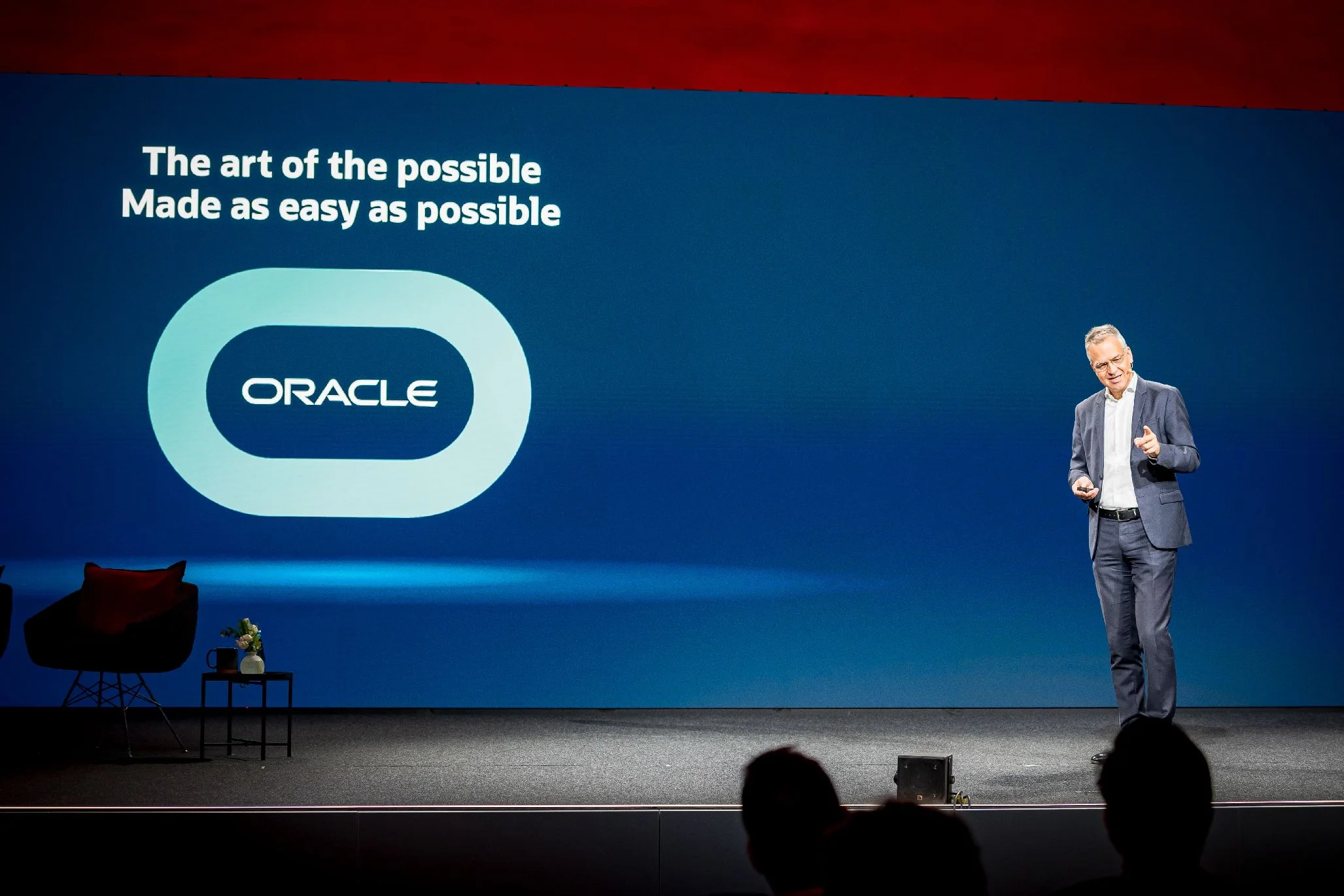
At the Oracle AI World Tour in Frankfurt on March 12, 2026, the company presented its multicloud strategy and agent-based AI applications—and openly addressed why Germany is falling behind in AI adoption.
Oracle used its AI World Tour stop in Frankfurt on March 12, 2026 to address an audience of several hundred corporate representatives across a broad range of topics: from financial records and cloud infrastructure to agent-based AI and the question of how far European data sovereignty actually extends in practice. The key takeaway: Oracle is no longer positioning itself merely as a database vendor, but as a full-stack AI provider—from the network layer to the application level.
Financial Tailwind
The backdrop for the event was provided by the quarterly results released the day before. Oracle reported total revenue of $17.2 billion for Q3 of fiscal year 2026—a 22 percent increase year-over-year. Cloud revenues rose by 44 percent to $8.9 billion. According to the company, it was the first quarter in more than 15 years in which both organic total revenue and non-GAAP earnings per share in US dollars grew by more than 20 percent. Adjusted EPS came in at $1.79, exceeding guidance.
Infrastructure as a Real Differentiator
The technical centerpiece of the event was Andrew Bond, CTO EMEA, who argued in his keynote why Oracle Cloud Infrastructure (OCI) is structurally different from other hyperscalers. The core argument: OCI was designed from the ground up as a bare-metal platform, without the legacy virtualization layers that have historically accumulated at older cloud providers. This translates into higher compute efficiency and a more favorable price-performance ratio. Bond pointed specifically to the RDMA network over RoCE v2, originally developed for high-density database workloads and now enabling AI superclusters. Oracle also offers 10 terabytes of monthly egress at no charge, with additional data priced at roughly ten percent of what other providers charge. OCI now delivers 8 million IOPS per instance in block storage, with an average latency of 350 microseconds.
Multicloud as Strategy, Not Compromise
Multicloud positioning was a thread running through multiple sessions. Bond argued it is a mistake to assume all hyperscalers are equivalent. Oracle now runs the Oracle Database in third-party clouds: after launching with Microsoft Azure in 2024, the service is now available at 50 locations with Google and AWS worldwide, with 18 additional AWS sites planned. Oracle also announced universal cross-cloud credits—a mechanism for transferring database credits between AWS, Azure, and Google Cloud. The underlying logic: portability as a sales argument for customers wary of single-vendor lock-in. “Choice by Design is the future of cloud” was a phrase that recurred in keynotes and customer conversations alike.
Sovereign Cloud: Where Regulation Meets Technical Reality
Data sovereignty carried particular weight at the event. Stefan Moch, Vice President Health at Arvato Systems, described his company’s situation in the customer panel: Arvato operates serialization services for pharmaceutical companies to combat counterfeit medicines across Europe—a highly regulated infrastructure. Since 2019, stricter EU requirements have applied to the storage and processing of health data. After migrating to OCI last year, Moch assessed the move as more positive than expected, noting that Oracle Sovereign Cloud provides the required level of control at a price point he considers fair. Geographically, Oracle operates Sovereign Cloud sites in Frankfurt and Madrid, both staffed exclusively with European personnel.
AI in Enterprise Applications: Agents, With Human Oversight
Hari Sankar, SVP Software Development at Oracle, presented the current state of AI integration in Oracle Fusion Applications, promising measurable results within 60 days. Examples included automated financial performance monitoring, agent-based HR workflows, and a natural-language SQL interface (OraPlan/NLSQL) currently supporting English and Chinese, with German to follow. Mark Lucas, VP Group HR Automation and Data at DHL, described a striking transformation: from 400 disparate HR systems down to a handful of core platforms, with around 200,000 of DHL’s 600,000 employees now consolidated on four Oracle instances. Oracle AI agents are increasingly replacing RPA solutions, enabling more productive HR processes while maintaining strict regulatory compliance.
Dr. Ingo Laue from Oracle’s product team outlined the general AI architecture vision: Oracle supports models from OpenAI, Meta, Cohere, Grok, and Google, as well as a range of additional providers via Hugging Face. Cohere is highlighted as particularly suited for enterprise scenarios involving proprietary data. For agent-based applications, Oracle has developed a reference architecture based on the Open Agent Specification standard from the Linux Foundation (the Agntcy project, co-developed with Cisco). Notably, an internal AI support assistant already resolves 64 percent of requests before a support ticket is ever opened.
Germany Lags Behind—And Knows It
Andreas Kiessling, VP Technology Sales at Oracle Germany, described a shift in customer conversations: meetings have increasingly moved to senior leadership levels, with CEOs now personally driving the AI agenda. Companies are no longer asking purely about technical implementation—they want strategic AI positioning. At the same time, Kiessling was candid about the obstacles: privacy concerns are real, the learning curve for AI implementation is steep, and the pursuit of perfection frequently delays adoption in Germany. “We need to be willing to fall short of a hundred percent,” he said in essence. He sees significant untapped potential in healthcare, pointing to institutions like the Mayo Clinic in the US as examples of what’s possible with AI built on real patient data—an area where Germany lags considerably.
The Oracle AI World Tour Frankfurt 2026 presented a company in confident forward motion: technically solid, financially strong, and increasingly willing to engage the German market not just with products, but with strategic candor. The message was clear: those who hesitate on AI will pay the price later.
Dr. Jakob Jung is Editor-in-Chief of Security Storage and Channel Germany. He has been working in IT journalism for more than 20 years. His career includes Computer Reseller News, Heise Resale, Informationweek, Techtarget (storage and data center) and ChannelBiz. He also freelances for numerous IT publications, including Computerwoche, Channelpartner, IT-Business, Storage-Insider and ZDnet. His main topics are channel, storage, security, data center, ERP and CRM.
Contact via Mail: jakob.jung@security-storage-und-channel-germany.de