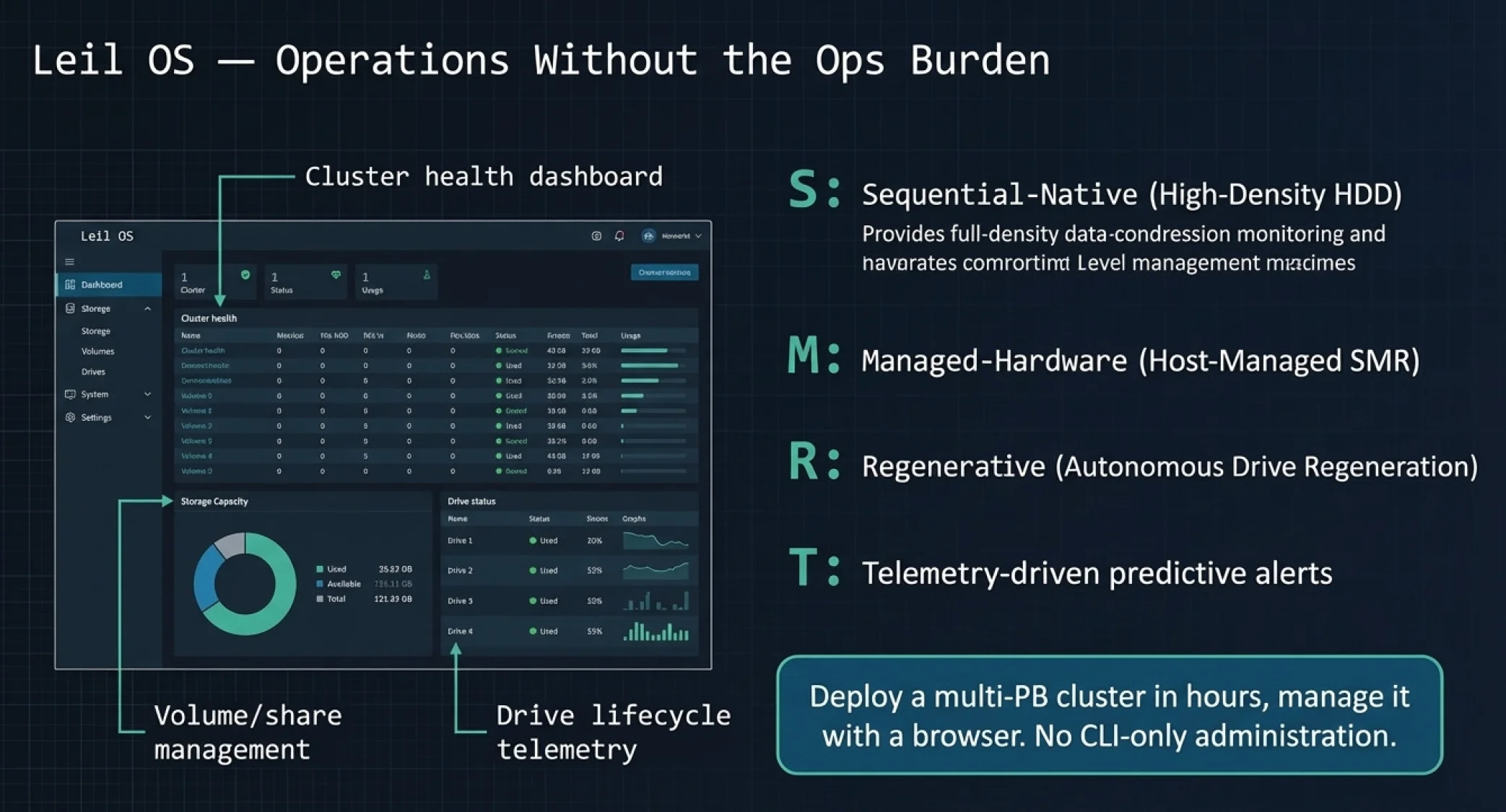
IT Press Tour: Leil has formally launched Leil OS, a storage operating system engineered from the ground up for shingled magnetic recording drives.
A Software Gap Hiding in Plain Sight
More than half of all high-capacity hard-disk drives shipped globally today use shingled magnetic recording (SMR), a recording technique that overlaps tracks to increase areal density and delivers roughly 20 to 25 percent more usable capacity per drive at the same manufacturing cost as a conventional drive. Yet the vast majority of enterprise storage software was designed for an entirely different physical reality — flash — and treats spinning media as little more than slow solid-state storage. The result is a structural mismatch that has quietly eroded data-center economics for years.
Aleksander Ragel, CEO and co-founder of the Estonian storage software company Leil, frames it plainly: hyperscalers such as Google, Meta, and Amazon have spent years engineering custom software stacks to exploit SMR’s density advantages. The other 90 percent of the market — enterprises, service providers, supercomputing centers, media organizations — has been left running general-purpose software on hardware it cannot fully use.
Leil was founded in Tallinn in 2022 to close that gap. After approximately three years of development, the company on April 1, 2026 formally announced Leil OS, a storage operating system built from line one for the physical characteristics of modern high-capacity HDDs, with native support for SMR drives at distributed, petabyte scale.
What the Software Actually Does
The core engineering claim is that Leil OS serializes all writes into large, aligned sequential streams — the only pattern SMR drives handle efficiently. Legacy distributed file systems typically issue small random I/O, causing excessive head seeks and write amplification that effectively nullifies the capacity advantages of SMR hardware. Leil says its system achieves 99 percent of theoretical maximum read throughput and approximately 95 percent write efficiency on SMR drives, figures the company says were verified in testing with two major drive manufacturers.
The architecture is organized into four layers. The client layer exposes a global POSIX namespace with simultaneous access over NFS v3/v4, SMB/CIFS, and S3, all embedded natively without translation gateways. Below that, a metadata layer handles distributed namespace management with sub-millisecond metadata operations from an NVMe-backed cache, with a distributed metadata server expected in the second half of 2026. The data layer manages chunk placement, replication, and erasure coding calculations — notably offloaded to the client rather than the storage nodes, reducing CPU overhead on storage hardware. At the base, the storage layer manages raw HDD pools, zoned recording, and sequential-optimized placement aligned to SMR zone boundaries.
Erasure coding profiles are configurable per file, ranging from 4+2 to 8+2 and beyond, allowing operators to tune the balance between capacity overhead and fault tolerance at a granular level. Background rebuilds are rate-limited to avoid saturating HDD bandwidth during production workloads.
Capacity, Latency, and Power
The primary commercial argument rests on three measurable outcomes. First, capacity: by fully managing SMR zones in software, Leil OS unlocks approximately 20 percent additional usable capacity per drive compared with a generic software-defined storage stack on identical hardware. At current 32 TB drive capacities, that translates to roughly six terabytes of additional storage per disk at no incremental hardware cost.
Second, retrieval latency. Leil positions its system as a nearline tier — a category it describes as largely absent from the market — that achieves millisecond-range random access times without the 45-minute robotic retrieval delays associated with tape, while remaining substantially cheaper per terabyte than cloud object storage. The company quotes a starting price of €0.99 per terabyte per month for Leil OS, against €2.50 or more for managed tape services and €3.50 to €20 for cloud storage depending on egress patterns.
Third, power consumption. Leil’s proprietary Infinite Cold Engine (ICE) uses the SATA/SAS Power Pin 3 standard to physically cut power to idle drives, targeting 70 percent baseline energy reduction over time. Current deployments already achieve 25 percent immediate energy savings. A complementary feature called Head Depopulation allows the system to retire a degraded platter surface on a 32 TB drive — sacrificing roughly five percent of that drive’s capacity — rather than pulling the entire disk and triggering a 24-hour rebuild cycle.
Addressing Tail Latency in AI Workloads
One technically specific feature targets AI training workflows directly. Legacy storage systems can experience priority blocking when a drive stalls on a difficult sector, causing the entire I/O queue to hang — a pattern that can abort long-running model training jobs. Leil OS implements SNIA Command Duration Limits (CDL), passing hard deadline hints to drive firmware. If a drive misses a 50-millisecond deadline, the system immediately reconstructs the missing data from erasure coding parity rather than waiting for the drive to recover. The company describes this as a mechanism to make HDD-based storage viable for warm-tier AI data pipelines feeding NVMe storage.
Product Structure and Open Source
Leil ships two products sharing a common codebase. Leil FS is an open-core parallel file system available under GPL-3.0, installable via standard Linux package repositories on Debian and Ubuntu today, with Fedora support in active development. It handles community adoption and serves as a no-lock-in exit path: because Leil OS is built directly on top of Leil FS, customers can revert to the open-source edition at any time without migrating data.
Leil OS is the commercial enterprise distribution, adding an SMR optimization engine, the ICE power management layer, a web-based management interface, drive lifecycle telemetry, and 24/7 support SLAs. Pricing is flat-rate per terabyte per month with no egress fees. OEM agreements carry a predictable 2 percent annual indexation plus the Euribor rate.
The company is simultaneously open-sourcing its Kubernetes operator and has completed a Proxmox plugin — moves aimed at reducing the friction for infrastructure engineers who want to evaluate the stack before committing to an enterprise deployment. The company states that installation via apt on a standard Linux system takes approximately ten minutes.
Reference Deployments
Leil cites four categories of production deployment. A national broadcaster uses the system for multi-petabyte video-on-demand origin storage, ingesting and delivering high-throughput streams simultaneously without frame drops. A regional hosting provider has replaced its legacy NAS infrastructure with Leil OS serving tens of thousands of users over native client protocols. Supercomputing centers are using the system for national digital archive projects requiring both POSIX and S3 access to the same namespace. Autonomous driving research programs are using it to stage large telemetry datasets feeding machine learning pipelines, where cost-per-terabyte is the dominant constraint.
Reference hardware configurations run from two-unit servers with 12 drives each for smaller deployments, up to racks of WDC Data102 JBOD enclosures with 102 drives of 32 TB each — a configuration the company says yields more than 25 petabytes of usable capacity per rack. When 40 TB drives become widely available, that figure is projected to reach 35 petabytes per rack.
Company and Competitive Context
Leil is a 14-person company, with nine to ten engineers actively writing code. The company is seed-funded, raised a seed round in autumn 2025, and says it is approaching breakeven. Its engineering team has specialized backgrounds in parallel file systems and distributed storage ecosystems, domains that typically require deep, hardware-level expertise that is difficult to assemble at early-stage scale.
The competitive landscape the company navigates includes Ceph, Lustre, and BeeGFS for distributed storage, as well as traditional NAS vendors. Leil’s differentiation claim rests not on raw performance benchmarks against flash-optimized systems but on TCO per usable terabyte for data that is accessed infrequently but must remain immediately retrievable — a segment where tape is the primary incumbent.
The company has technology alliance validations with Western Digital, Seagate, ATTO Technology, NVIDIA, Broadcom, Intel, and AMD, and describes itself as actively participating in SNIA and OCP standards work on HM-SMR adoption. A native flash support tier using a Host-Managed Over-Provisioning (HM-OP) protocol is listed on the roadmap for 2027, with the company projecting that graceful degradation logic could extend flash drive lifespan from five to seven or more years, reducing failure-related TCO by a claimed 83 percent.
Leil FS remains free and available for university research environments as part of the company’s stated intent to build a pipeline of engineers familiar with the stack before they reach enterprise procurement roles.

Dr. Jakob Jung is Editor-in-Chief of Security Storage and Channel Germany. He has been working in IT journalism for more than 20 years. His career includes Computer Reseller News, Heise Resale, Informationweek, Techtarget (storage and data center) and ChannelBiz. He also freelances for numerous IT publications, including Computerwoche, Channelpartner, IT-Business, Storage-Insider and ZDnet. His main topics are channel, storage, security, data center, ERP and CRM.
Contact via Mail: jakob.jung@security-storage-und-channel-germany.de