At the IT Press Tour’s 67th edition in Sofia, PoINT Software & Systems laid out a product strategy that treats the Amazon S3 API not as a cloud gateway but as a universal interface for on-premises archiving at scale.
When PoINT Software & Systems presented at the 67th edition of the IT Press Tour in Sofia on April 1, 2026, the session carried an undertone that has become familiar across European IT: a wariness toward public cloud dependency and a renewed interest in infrastructure that organisations can control physically and legally. Founded in 1994 in Wiehl, a town between Cologne and Frankfurt, PoINT has spent three decades building data management software without external investment, navigating the collapse of optical storage, the rise of hard disk archiving, and the eventual dominance of object storage — all while remaining a privately held company with a team small enough to be flexible but experienced enough to hold its ground in an enterprise market increasingly crowded with well-funded competitors.
The company traces its lineage to 1985, when the founders worked within Philips’ world-wide competence centre for software development. Philips was, at the time, the inventor of CD recording, and the team built the first archiving software for that medium — a CD-ROM file service for Unix systems. After Digital Equipment Corporation acquired the IT activities of Philips in 1991, the group eventually completed a management buyout in 1994 and established PoINT Software & Systems GmbH. The name — an acronym for Partner for Optical and Innovative Technology — has outlasted the medium it described. Optical storage is now functionally extinct as a commercial product line, but the name remained. Thomas Thalmann has been at the helm of the company for ten years now. He also spoke at the event in Sofia.
The company’s first commercial success was the PoINT Jukebox Manager, launched in 1997, which provided native file system access to optical jukeboxes and accumulated more than 2,500 worldwide licences at its peak. The market collapsed when hard disk prices fell sharply in the early 2000s, and optical archiving effectively disappeared within two years. Rather than exit the market, PoINT pivoted to building a storage management layer that could sit above any storage technology — flash, disk, tape, optical, object storage, and public cloud — and move data between them based on defined policies.
That product, the PoINT Storage Manager, launched in 2007 and now counts more than 200 installations worldwide. It performs file tiering and archiving using an active approach — policy-driven migration of inactive files from primary storage to secondary or archive tiers — while maintaining transparent access through stub files. A client opening a file stored on tape or object storage retrieves it via a pass-through mechanism without any visible interruption, unless the file is opened for editing, in which case it is restored to primary storage. A separate passive mode, the PoINT Archive File System, instantly archives newly created files and marks them as WORM-protected, using access timestamps to encode retention periods without requiring a proprietary retention database.
The largest current installation of the Storage Manager is at Daimler, which runs the product across 270 locations worldwide. Daimler uses two private cloud object storage deployments as archive targets and routes inactive data from primary NAS systems — primarily NetApp and Dell EMC — into this private cloud infrastructure. According to PoINT’s presentation, the cost savings measured over one to three years reached into the millions of euros, driven by the avoidance of expensive primary storage expansion.
Another reference customer is SIXT. The mobility service provider stored home directories containing large amounts of unstructured data on primary storage systems. To address this issue, the company opted for PoINT Storage Manager (PSM) software, which moves rarely used data to secondary storage, thereby offloading these systems. It is essential that users can still access the moved data. PSM provides transparent read access beyond the data center’s boundaries to meet this requirement. “PoINT Storage Manager continues to make the offloaded data available to users for reading beyond the data center’s boundaries. PSM reliably handles our challenges, which is why we are very satisfied with the software. In addition to the intuitive installation and functionalities, we particularly appreciate the ‘short decision-making paths’ at PoINT Software & Systems,” explains Stefan Kerber, Head of Data Center Management at SIXT.
The product receiving the most attention at the Sofia session, however, was the PoINT Archival Gateway, launched in 2021. This is the company’s S3-to-Tape implementation — software that presents a fully Amazon S3-compatible interface to any application or storage system while writing data directly to physical tape libraries. The gateway requires no intermediate hard disk layer; data streams from the S3 client through RAM into a tape driver in 64-kilobyte blocks, with the database service committing the write back to the S3 client once the data is on tape. An optional disk caching layer is available for workloads that benefit from it, but it is not architecturally required.
The system divides responsibilities between Interface Nodes, which handle the S3 REST API and control drives and robotics, and Database Nodes, which maintain the object database, logs, and an HTML administration interface backed by a RESTful admin API. The Compact Edition runs as a single-node deployment supporting up to two tape libraries and eight drives, with a failover cluster variant providing geo-distribution across two sites. The Enterprise Edition scales to 32 Interface Nodes, 12 tape libraries, and 384 drives, with a maximum native throughput of 153.6 GB/s. The system supports LTO-5 through LTO-10 tape formats and IBM 3592 drives from the TS1150 to TS1170 generation, including mixed-format libraries.
Redundancy is implemented through erasure coding rather than simple mirroring, with EC rates of 1/2, 1/3, and 1/4 available for pure redundancy and rates of 2/4 and 3/4 enabling parallel drive usage to increase write throughput. Geo-distribution is supported across WAN links with latency up to 100 milliseconds, with automatic failover and re-synchronisation after a site failure. A large unnamed US deployment, managing approximately 150 petabytes across two geographically separated data centres, tested the limits of this architecture — specifically the challenge of maintaining database consistency across a 60-millisecond WAN link while also handling the slight capacity differences between individual tape cartridges during re-synchronisation after a site outage.
The S3 performance figures cited for the Enterprise Edition are significant: more than 50 billion objects per bucket, more than 10,000 buckets, more than 100,000 parallel HTTP connections, and more than 1,000 simultaneous S3 application clients. An optional disk storage class can be added to the tape namespace, presenting both as a unified S3 interface with lifecycle policies that move data from disk to tape automatically — a tiering model that mirrors the public cloud’s own Glacier archiving tier, but on infrastructure the customer controls.
A joint product developed in cooperation with BDT, the world’s largest tape library manufacturer, and the reseller COMBACK combines the BDT ORION MC6 tape library with the PoINT Archival Gateway software in a single rack-integrated appliance called ORION S3. The 48U library section accommodates up to seven modules, 974 slots, 21 full-height drives, and up to 29 petabytes of native LTO-10 capacity. The 6U S3 head houses the PoINT Archival Gateway servers. Multiple units can be combined to reach 13,380 slots, 288 drives, and 392 petabytes of native capacity across 12 libraries. This marks the first time BDT has brought a product to market under its own brand, having previously manufactured tape libraries exclusively as OEM hardware for IBM, HP, and others.
The third product in PoINT’s portfolio, the PoINT Data Replicator, addresses replication of object and file data to S3-capable targets. Its primary use cases are cloud repatriation — migrating data from public cloud back to on-premises object storage — S3-to-S3 bucket synchronisation, protection of existing cloud and object storage through backup to tape, and migration of legacy NAS file systems to modern object storage. The replicator operates in two modes: S3-to-S3, which replicates objects including metadata, tags, object lock settings, and ACLs; and File-to-S3, which maps the original file path as the S3 object key and retains directory structure. Integration with the PoINT Archival Gateway enables tape-optimised restore operations by sorting read requests according to physical position on tape, substantially reducing seek time on large restores.
The Kafka and SQS messaging integrations allow the Data Replicator to track object creation events in real time, eliminating the need to rescan large buckets between replication runs and enabling near-continuous replication without scheduled full scans. Snapshot restore allows recovery to a specific point in time rather than only to the most recent state.
The customer base shown at Sofia included Sixt, Daimler, the Max Planck Institute for Heart and Lung Research, Bayern Invest, Reisebank, PostFinance, Amgen, EMBL-EBI, the Stadt Hof, EUROIMMUN, and St. Augustinus Kliniken, spanning automotive, financial services, life sciences, healthcare, and public administration. A case study for PostFinance described a two-site geo-distributed deployment using the Archival Gateway alongside Cloudian object storage and Quantum tape libraries, with asynchronous replication at the object level providing a cost-effective protection layer. The EMBL-EBI deployment — the European Bioinformatics Institute — manages data volumes in the high three-digit petabyte range, archiving Kubernetes workloads via S3 with read and write performance exceeding one petabyte per week.
During the question period, the session moderator raised the legal status of the Amazon S3 API following reports that Amazon had signalled potential restrictions. PoINT’s position was measured: S3 is a de facto industry standard, not an ISO-ratified specification, but its breadth of adoption across every significant object storage vendor makes unilateral restriction practically unenforceable. The company noted that an earlier attempt to establish an ISO standard for object storage — CDMI — had failed precisely because the market consolidated around S3 instead, leaving at least one large French research institution that had built on CDMI facing a migration to S3.
On the broader question of storage media succession, PoINT acknowledged awareness of emerging technologies — glass-based storage, DNA storage, and similar long-horizon research — but stated plainly that for the foreseeable future, tape remains the only medium that simultaneously satisfies the requirements of low cost per terabyte, zero energy consumption for inactive data, air-gap security against ransomware, and physical longevity sufficient for regulatory archiving. The S3 interface layer above the tape hardware means that when a successor medium eventually becomes commercially viable, the application-facing interface does not need to change.
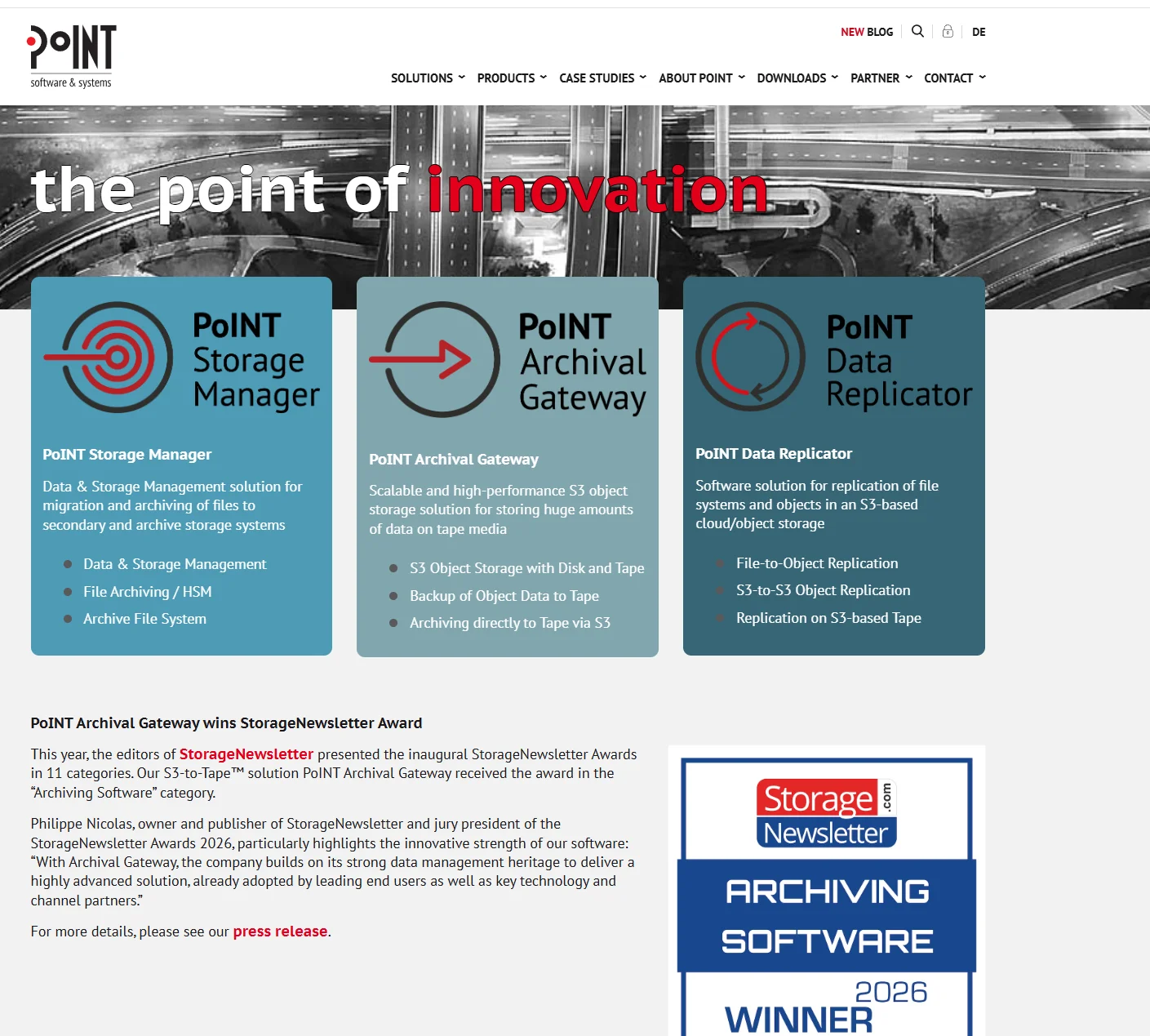
PoINT received the EU Commission’s Go Green and Be Resilient Award and holds the Storage Newsletter Archiving Software Winner 2026 designation and the Software Made in Europe label for 2026. Development, support, and sales are conducted entirely from Germany.

Dr. Jakob Jung is Editor-in-Chief of Security Storage and Channel Germany. He has been working in IT journalism for more than 20 years. His career includes Computer Reseller News, Heise Resale, Informationweek, Techtarget (storage and data center) and ChannelBiz. He also freelances for numerous IT publications, including Computerwoche, Channelpartner, IT-Business, Storage-Insider and ZDnet. His main topics are channel, storage, security, data center, ERP and CRM.
Contact via Mail: jakob.jung@security-storage-und-channel-germany.de