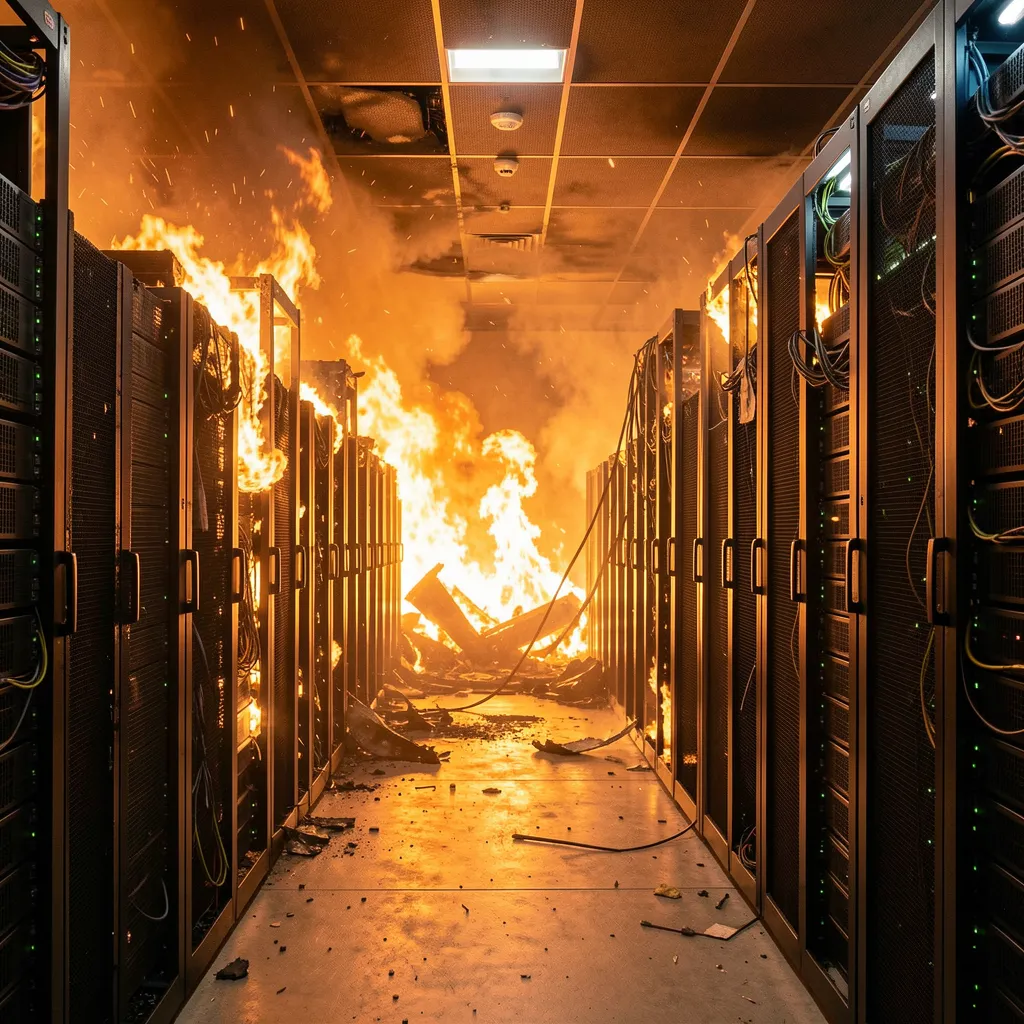
War and Watts: How Middle East Conflict Is Reshaping Data Centre Strategy.
DC Byte analysis: Targeted strikes on data facilities in the Middle East have remained limited in scale — but the conflict is accelerating a structural rethink of resilience, supply chains and investment risk across the region’s fast-growing digital infrastructure sector.
When military strikes hit data centre facilities in the Middle East in recent weeks, the immediate damage was contained. Of the 233 data centre developments across GCC (Gulf Cooperation Council) countries, the five facilities affected represent between one and two percent of the regional market. No systemic outage occurred. Workloads were rerouted. Operations continued. Yet the events have set in motion a more deliberate reassessment of how digital infrastructure is planned, built and insured in one of the world’s most strategically watched regions.
The Gulf states — Saudi Arabia, the UAE and Qatar in particular — have in recent years attracted substantial investment from hyperscalers and cloud providers. Low latency requirements, data sovereignty frameworks and ambitious national digitalisation programmes have made the region a target for capital. That underlying logic has not changed. According to market data, the GCC currently holds around 2.4 gigawatts of qualified capacity, with more than 2 gigawatts in early-stage development. No major real estate investor or hyperscaler has announced a pause or withdrawal.
But the conflict has exposed vulnerabilities — not fatal ones, but instructive ones — in how the sector models and manages risk.
Physical Infrastructure and Resilience Design
Large-scale data centre facilities are not built to civilian standards. Hardened structures, redundant power and cooling systems, controlled perimeters and fire suppression infrastructure are standard features at hyperscale campuses. Workload distribution across multiple availability zones means that damage to a single facility does not necessarily translate into service disruption for customers.
In practice, this architecture performed as designed during the recent strikes. Where individual facilities were affected, traffic was redirected with limited customer impact. The events are therefore unlikely to trigger wholesale abandonment of regional deployments. What they are more likely to produce is a refinement of physical risk modelling — factoring in proximity to strategic targets, airspace conditions and distance from military or industrial infrastructure — rather than a departure from the market itself.
Connectivity and Network Routing Constraints
If physical resilience held up relatively well, network connectivity proved a more complex challenge. Even where data centres remained operational, routing constraints led to temporary increases in latency and congestion during high-traffic periods. The ability to redirect workloads quickly depends not only on facility redundancy but on the availability of diverse cable routes.
The conflict has underscored the degree to which connectivity diversification — across both subsea and terrestrial routes — is a prerequisite for genuine operational resilience. Operators and hyperscalers are expected to place greater emphasis on building redundancy into network infrastructure in parallel with facility investment.
Supply Chain Disruption
The most immediate and tangible economic impact has been on supply chains. Disruption to shipping through the Strait of Hormuz has driven up freight costs and introduced material delays to project timelines. Equipment procurement for capital-intensive infrastructure projects — servers, cooling systems, power infrastructure — requires long lead times under normal conditions. Conflict-driven disruption compounds those timelines significantly.
“One of the biggest short-to-medium term impacts we’re seeing is in data centre supply chains. Getting big ticket items delivered to the region safely has become difficult. As a result, shipping costs have already increased substantially, and the region is being hit with further delays and price increases as the conflict escalates.” — Scott Roots, Sales Director EMEA, DC Byte
For operators with active construction programmes, this translates into revised project economics and extended delivery schedules. Alternative supply routes are under evaluation, though none offer the cost efficiency of established shipping lanes.
Cyber and Hybrid Threat Dimensions
Modern conflicts are rarely confined to kinetic engagements. Cyberattacks targeting critical infrastructure have become a standard component of contemporary warfare, and data centres — as nodes of economic and communications infrastructure — represent credible targets. Most major operators already integrate cyber risk into their security frameworks. The current situation is accelerating that focus rather than introducing new concepts.
Areas receiving closer attention include the coordination of cyber and physical security responses, the exploitation of operational disruptions as cover for network intrusion, and resilience planning for scenarios where infrastructure operators face simultaneous threats across multiple attack surfaces. In the longer term, greater integration between cyber defence and physical security planning may strengthen the sector’s overall resistance to external shocks.
Investment and Insurance Recalibration
Investment confidence in the GCC data centre market remains intact for now, but the risk calculus is shifting at the margins. Insurers and investors are beginning to examine political risk exposure with greater scrutiny, and due diligence processes are likely to place increased weight on site resilience and infrastructure proximity risks. Insurance coverage requirements may be adjusted to reflect elevated threat environments.
The more probable consequence is a revision of project economics and planning timelines rather than a pullback from the region. Developers with long investment horizons may absorb short-term disruption, but rising costs — from supply chain pressures, enhanced security requirements and insurance adjustments — will factor into return calculations.
Strategic Adjustments Across the Sector
The conflict is prompting a set of operational and strategic adjustments that extend beyond the immediate theatre of events. Operators are likely to prioritise infrastructure diversity more explicitly, distributing capacity across facilities and jurisdictions to reduce concentration risk. Site selection criteria are being reviewed, with geopolitical proximity and infrastructure exposure receiving greater analytical weight.
Accelerated investment in alternative cable routes — both subsea and terrestrial — appears probable as operators seek to build genuine network redundancy rather than rely on primary routing infrastructure. And for businesses operating in adjacent markets, the conflict serves as a prompt to review disaster recovery plans and stress-test failover procedures.
“The conflict highlights the interaction between geopolitical events and digital infrastructure, rather than demonstrating a fundamental vulnerability in regional data centre operations. The most likely impact may be around increased focus on redundancy and resilience design, more detailed risk modelling for physical infrastructure and adjustments to investment and insurance assumptions.” — Bernard Johnson, CEO, DC Byte
The GCC data centre market was not built to be fragile. The architecture, the investment scale and the strategic importance of the region’s digital infrastructure all point toward continuity. What the past weeks have demonstrated is that continuity requires ongoing work — in risk modelling, supply chain management, network architecture and security integration. The fundamentals of the market remain in place. The assumptions underpinning them are under review.

Dr. Jakob Jung is Editor-in-Chief of Security Storage and Channel Germany. He has been working in IT journalism for more than 20 years. His career includes Computer Reseller News, Heise Resale, Informationweek, Techtarget (storage and data center) and ChannelBiz. He also freelances for numerous IT publications, including Computerwoche, Channelpartner, IT-Business, Storage-Insider and ZDnet. His main topics are channel, storage, security, data center, ERP and CRM.
Contact via Mail: jakob.jung@security-storage-und-channel-germany.de