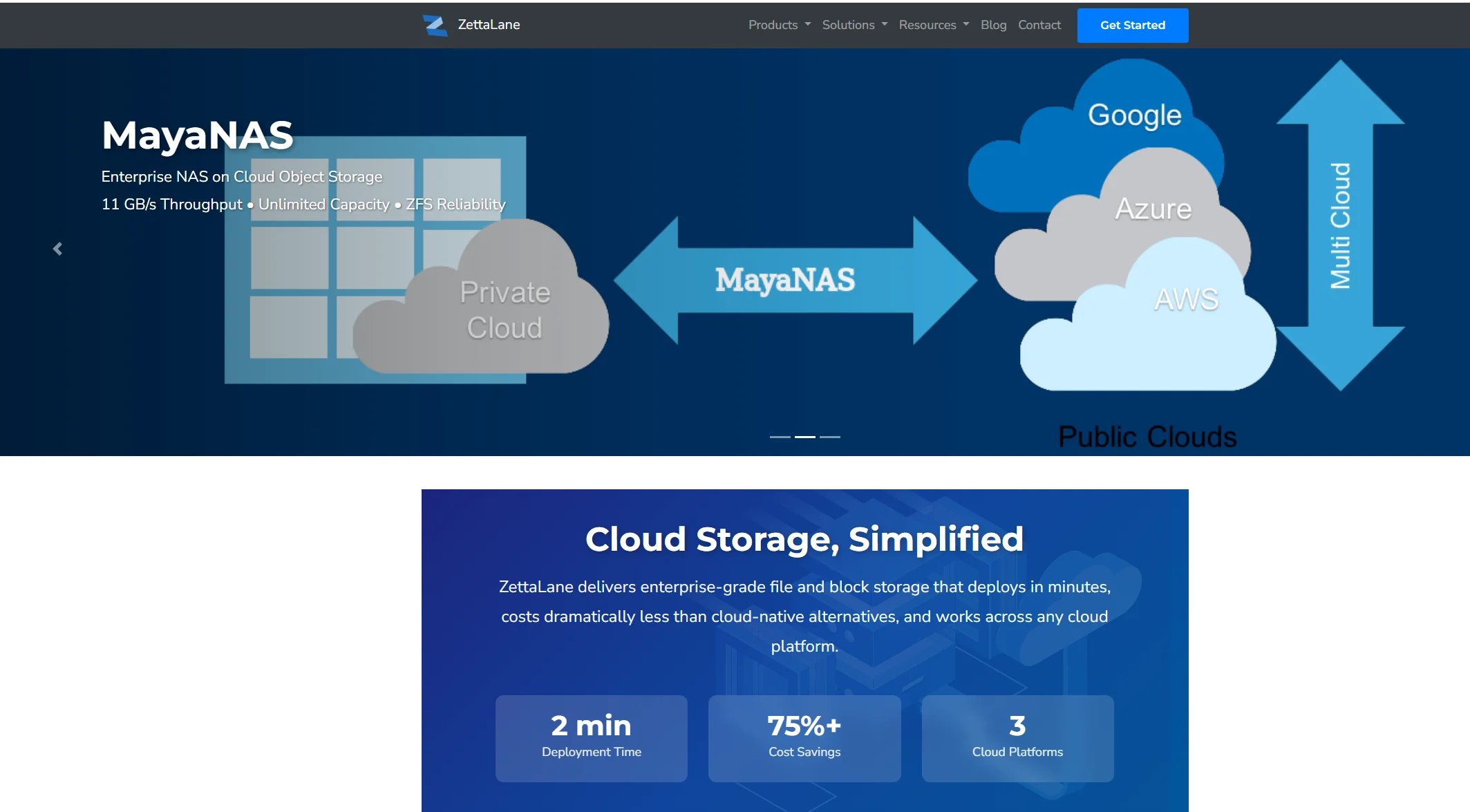
| Zettalane Systems schließt mit hybrider Architektur die Kostenlücke bei Cloud-Speichern, wie auf der IT Press Tour gezeigt. | Zettalane Systems Addresses Cloud Storage Cost Gap with Hybrid Architecture as shown on IT Press Tour. |
| Das in Santa Clara ansässige Unternehmen Zettalane Systems hat zwei Speicherlösungen namens MayaNAS und MayaScale vorgestellt. Beide zielen auf das ab, was Gründer Supramani Sammandam als erhebliche Preisunterschiede bei Cloud-nativen Speichern identifiziert hat. Der Ansatz des Unternehmens kombiniert bewährte Technologien – ZFS-Dateisysteme, NVMe-Speicher und Objektspeicher – in Konfigurationen, die darauf ausgelegt sind, Kosten zu senken und gleichzeitig die Leistung aufrechtzuerhalten. Das Unternehmen stellte MayaNAS und MayaScale auf dem OpenZFS Developer Summit im Dezember 2025 in Portland, Oregon, vor. Im Mittelpunkt der Präsentation stand objbacker.io – eine native ZFS-VDEV-Implementierung für Objektspeicher, die FUSE vollständig umgeht und einen Lesedurchsatz von 3,7 GB/s direkt aus S3, GCS und Azure Blob Storage erreicht.
Das Kostenproblem Die Preise für Cloud-Speicher variieren je nach Art des Dienstes erheblich. Bei AWS kostet Blockspeicher über EBS gp3 etwa 0,08 US-Dollar pro GB und Monat, was bei 100 TB jährlichen Kosten von 96.000 US-Dollar entspricht. Verwalteter Dateispeicher über EFS kostet 0,30 US-Dollar pro GB und Monat – bei gleicher Kapazität sind das 360.000 US-Dollar pro Jahr. Zettalane behauptet, dass seine Lösungen eine Kostenreduzierung von 70 % ermöglichen. Verwaltete Cloud-Dateidienste unterliegen Leistungsbeschränkungen. Die beworbenen Durchsatzraten erfordern in der Regel Bereitstellungen von mehr als 100 TB, während der Durchsatz pro Client trotz hoher Gesamtleistung zu Engpässen führen kann. MayaNAS: Hybrider Dateispeicher Das Produkt MayaNAS des Unternehmens implementiert eine mehrschichtige Architektur unter Verwendung von ZFS mit Objektspeicher-Backends. Kleine Blöcke unter 128 KB – Konfigurationsdateien, Metadaten, Auftragsparameter – werden an ZFS-Spezialvolumes auf NVMe-Speicher weitergeleitet, um eine geringe Latenz und hohe IOPS zu erzielen. Große Datenblöcke nutzen Objektspeicher für Kosteneffizienz und Durchsatz. Zettalane hat objbacker.io entwickelt, eine native ZFS-VDEV-Schnittstelle für Objektspeicher, die herkömmliche FUSE-Schichten umgeht. Anstatt große E/A-Operationen in 4-KB-Anfragen aufzuteilen, verwendet das System Anbieter-SDKs für S3, Google Cloud Storage und Azure Blob Storage mit direkter Kernel-Integration, wodurch gleichzeitige Anfragen möglich sind, die die Bandbreite des Objektspeichers auslasten. Das Unternehmen berichtet von validierten Benchmarks auf der Google Cloud Platform, die einen gleichzeitigen Lesedurchsatz von 8,14 GB/s und einen Schreibdurchsatz von 6,2 GB/s unter Verwendung von zwei n2-standard-48-Instanzen in einer Active-Active-Hochverfügbarkeitskonfiguration zeigen. MayaScale: Blockspeicher mit geringer Latenz MayaScale zielt auf Datenbank- und Analyse-Workloads ab, die eine Latenz von weniger als einer Millisekunde erfordern. Das Produkt bündelt lokale NVMe-SSDs über Instanzen in Active-Active-Synchron-Spiegelkonfigurationen und arbeitet entweder im Linux-RAID-1-Modus für Blockspeicher oder im ZFS-Modus für Dateispeicher. Die Architektur führt die Spiegelung serverseitig statt clientseitig durch. Clients schreiben einmalig in einen Speicherknoten, der intern zu seinem Partner gespiegelt wird, wodurch der doppelte Netzwerkverkehr von clientseitigen Ansätzen vermieden wird. Die Leistungsstufen reichen von „Basic“ bis „Ultra“. Auf der Google Cloud Platform bietet die Stufe „Basic“ 101.000 Lese-IOPS und 75.000 Schreib-IOPS bei einer Latenz von 129 µs für 299 US-Dollar pro Monat. Die Stufe „Ultra“ erreicht 2,28 Millionen Lese-IOPS und 733.000 Schreib-IOPS bei einer Latenz von 173 µs für 4.536 US-Dollar pro Monat. Datenbank-Benchmarks mit PostgreSQL pgbench verzeichneten 96.000 Transaktionen pro Sekunde mit serverseitiger RAID-1-Hochverfügbarkeit. Multi-Cloud-Bereitstellung Beide Produkte werden unter Verwendung konsistenter Architekturen auf AWS, Google Cloud und Azure bereitgestellt. Die Bereitstellung erfolgt über zweiminütige Terraform-Workflows mit automatischer Konfiguration von NFS-Exporten, Hochverfügbarkeits-Spiegelung und virtueller IP-Einrichtung. Marktpositionierung Zettalane berechnet beide Produkte pro vCPU-Stunde ohne zusätzliche Gebühren pro GB oder pro IOPS. Das Unternehmen zielt mit MayaNAS auf KI/ML-Training, Medienproduktion, Datenanalyse und Softwareentwicklung ab. MayaScale richtet sich an Datenbanken, Analyseplattformen und persistente Volumes von Kubernetes. Das Unternehmen hat den Partnerstatus bei AWS, Google Cloud und Azure erreicht und beide Produkte in deren Marktplätzen gelistet. |
Zettalane Systems based in Santa Clara has introduced two storage solutions named MayaNAS and MayaScale. Both are targeting what founder Supramani Sammandam identifies as a significant pricing disparity in cloud-native storage. The company’s approach combines established technologies—ZFS file systems, NVMe storage, and object storage—in configurations designed to reduce costs while maintaining performance. The company presented MayaNAS and MayaScale at OpenZFS Developer Summit in December 2025 in Portland, Oregon. The centerpiece of the presentation was objbacker.io—a native ZFS VDEV implementation for object storage that bypasses FUSE entirely, achieving 3.7 GB/s read throughput directly from S3, GCS, and Azure Blob Storage.
The Cost Problem Cloud storage pricing varies substantially by service type. On AWS, block storage through EBS gp3 costs approximately $0.08 per GB monthly, translating to $96,000 annually for 100TB. Managed file storage via EFS costs $0.30 per GB monthly—$360,000 yearly for the same capacity. Zettalane claims its solutions deliver 70% cost reduction. Managed cloud file services face performance constraints. Advertised throughput rates typically require deployments exceeding 100TB, while per-client throughput can bottleneck despite high aggregate performance. MayaNAS: Hybrid File Storage The company’s MayaNAS product implements a tiered architecture using ZFS with object storage backends. Small blocks under 128KB—configuration files, metadata, job parameters—route to ZFS Special volumes on NVMe storage for low latency and high IOPS. Large data blocks utilize object storage for cost efficiency and throughput. Zettalane developed objbacker.io, a native ZFS VDEV interface for object storage that bypasses traditional FUSE layers. Rather than splitting large I/O operations into 4KB requests, the system uses vendor SDKs for S3, Google Cloud Storage, and Azure Blob Storage with direct kernel integration, enabling concurrent requests that saturate object storage bandwidth. The company reports validated benchmarks on Google Cloud Platform showing 8.14 GB/s concurrent read throughput and 6.2 GB/s write throughput using two n2-standard-48 instances in Active-Active high availability configuration. MayaScale: Low-Latency Block Storage MayaScale targets database and analytics workloads requiring sub-millisecond latency. The product pools local NVMe SSDs across instances in Active-Active synchronous mirror configurations, operating in either Linux RAID-1 mode for block storage or ZFS mode for file storage. The architecture performs mirroring server-side rather than client-side. Clients write once to a storage node, which internally mirrors to its partner, avoiding the doubled network traffic of client-side approaches. Performance tiers range from Basic to Ultra. On Google Cloud Platform, the Basic tier delivers 101K read IOPS and 75K write IOPS at 129µs latency for $299 monthly. The Ultra tier reaches 2.28M read IOPS and 733K write IOPS at 173µs latency for $4,536 monthly. Database benchmarks using PostgreSQL pgbench recorded 96,000 transactions per second with server-side RAID-1 high availability. Multi-Cloud Deployment Both products deploy across AWS, Google Cloud, and Azure using consistent architectures. Deployment occurs through two-minute Terraform workflows with automatic configuration of NFS exports, high availability mirroring, and virtual IP setup. Market Positioning Zettalane prices both products per vCPU-hour without additional per-GB or per-IOPS charges. The company targets AI/ML training, media production, data analytics, and software development for MayaNAS. MayaScale addresses databases, analytics platforms, and Kubernetes persistent volumes. The company has achieved partner status with AWS, Google Cloud, and Azure, listing both products on their marketplace. |
Dr. Jakob Jung ist Chefredakteur Security Storage und Channel Germany. Er ist seit mehr als 20 Jahren im IT-Journalismus tätig. Zu seinen beruflichen Stationen gehören Computer Reseller News, Heise Resale, Informationweek, Techtarget (Storage und Datacenter) sowie ChannelBiz. Darüber hinaus ist er für zahlreiche IT-Publikationen freiberuflich tätig, darunter Computerwoche, Channelpartner, IT-Business, Storage-Insider und ZDnet. Seine Themenschwerpunkte sind Channel, Storage, Security, Datacenter, ERP und CRM.
Kontakt – Contact via Mail: jakob.jung@security-storage-und-channel-germany.de