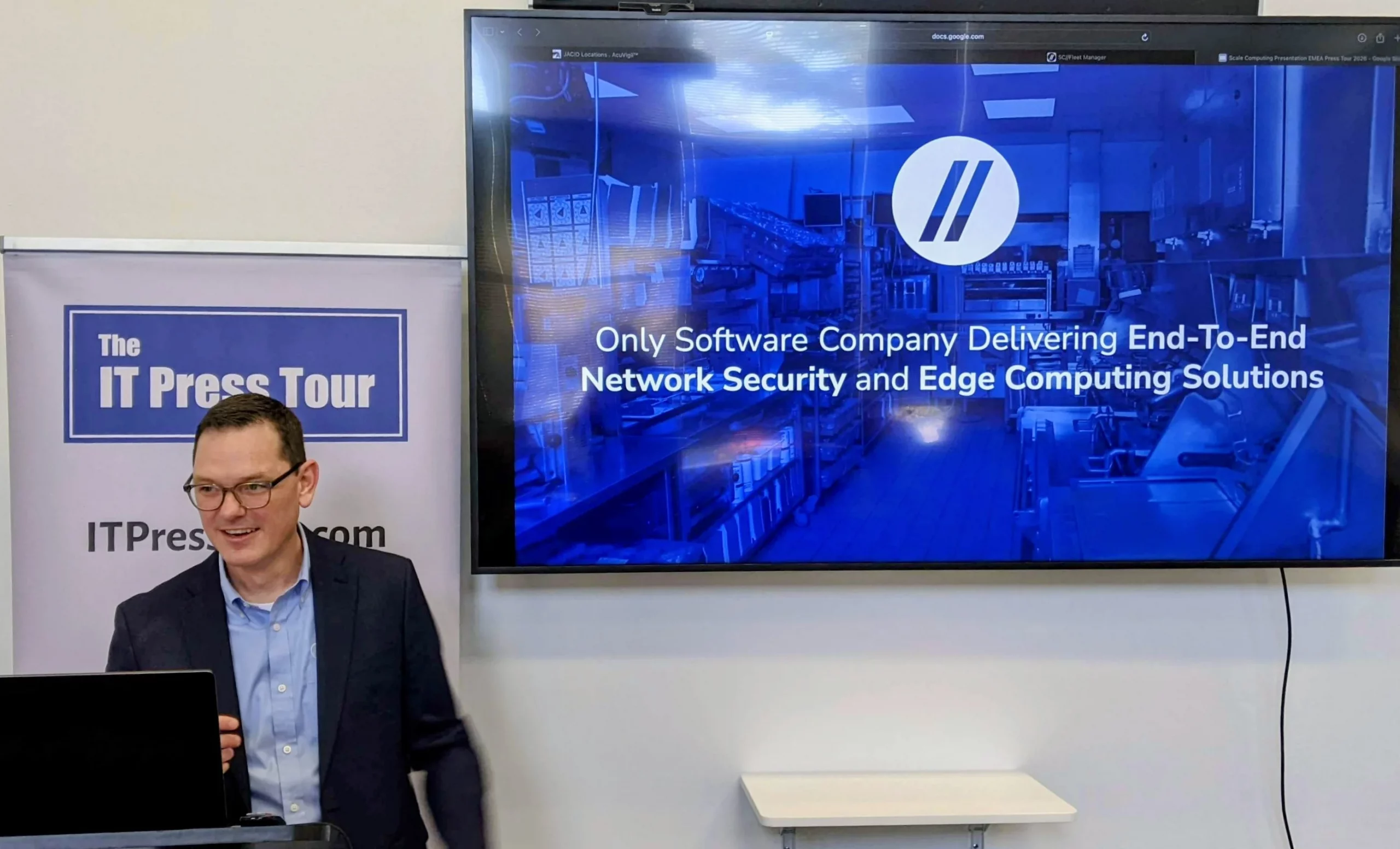
| Scale Computing verbindet Edge-Computing mit Netzwerksicherheit und verwaltet verteilte Standorte über eine integrierte Virtualisierungsplattform, wie auf der IT Press Tour gezeigt. | Scale Computing merges edge computing with network security, managing distributed sites through integrated virtualization platform as shown on IT Press Tour. |
| Scale Computing hat nach der Fusion mit Acumera seine Edge-Computing- und Netzwerkaktivitäten konsolidiert und damit eine integrierte Plattform für verteilte Unternehmensinfrastrukturen geschaffen. Das fusionierte Unternehmen verwaltet nun über 100.000 Standorte und 250.000 Edge-Computing-Workloads in 30 Ländern.
Durch die Fusion werden die Virtualisierungs- und Edge-Orchestrierungsfähigkeiten von Scale Computing mit der zwei Jahrzehnte langen Erfahrung von Acumera im Bereich sicherer Edge-Netzwerke und Netzwerkbetrieb zusammengeführt. Die Integration adressiert eine technische Herausforderung, mit der Unternehmen mit verteilten Betrieben konfrontiert sind: die Verwaltung von Rechenressourcen, Netzwerkinfrastruktur und Sicherheitskontrollen über separate Systeme und Anbieter hinweg. Technische Architektur Die Virtualisierungssuite SC//HyperCore des Unternehmens kombiniert Rechenleistung, Speicher und Virtualisierung in einer einzigen Software-Schicht, die auf handelsüblichen x86-Servern läuft. Das System verfügt über automatisierte Wiederherstellungsmechanismen, die Infrastrukturprobleme ohne manuelles Eingreifen erkennen und beheben. Dieser Ansatz steht im Gegensatz zu herkömmlichen dreistufigen Architekturen, bei denen Rechenleistung, Speicher und Netzwerk in separate Hardware-Schichten unterteilt sind. Für die zentralisierte Verwaltung bietet SC//Fleet Manager eine cloudbasierte Orchestrierung über mehrere HyperCore-Cluster hinweg. Die Plattform umfasst Zero-Touch-Provisioning für automatisierte Bereitstellungen und Funktionen für das Anwendungslebenszyklusmanagement, die Software-Updates für ganze Flotten ohne Vor-Ort-Besuche ermöglichen. Unternehmen mit Tausenden von Standorten können Anwendungsänderungen oder -updates von einer zentralen Konsole aus vornehmen, anstatt jeden Standort einzeln zu verwalten. Der verwaltete Netzwerkdienst SC//AcuVigil bietet softwaredefinierte Wide Area Networking- und Firewall-Funktionen der nächsten Generation über gehärtete Netzwerkgeräte. Diese Systeme unterstützen Hochverfügbarkeitskonfigurationen und bieten Transparenz über Switches, Ports und Endpunktkonnektivität in verteilten Umgebungen. Bereitstellungsmodelle und Anwendungsfälle Scale Computing bietet zwei primäre Bereitstellungsmodelle. Der SC//Platform-Ansatz verwendet lokale HyperCore-Cluster mit Fleet Manager-Orchestrierung und eignet sich für Unternehmen, die es vorziehen, die Infrastruktur selbst zu besitzen und zu betreiben. Die SC//Reliant-Plattform bietet Edge-Computing als Service mit einem webbasierten Managementsystem und einer dedizierten Serverumgebung für zentralisierte Abläufe. Aktuelle Implementierungen veranschaulichen die Anwendung der Plattform in verschiedenen Branchen. Die Breedon Group, ein britisches Baustoffunternehmen, das in Großbritannien, Irland und den Vereinigten Staaten tätig ist, ersetzte die alte Infrastruktur an entfernten Standorten durch HyperCore-Cluster. Das Unternehmen implementierte HE151 NUC-Cluster an Standorten mit begrenzter Konnektivität und minimalem IT-Personal, um die IoT-Datenerfassung und PowerBI-Integration über Azure IoT Hub zu unterstützen. Advance Auto Parts implementierte die Plattform in seinem Netzwerk von mehr als 4.500 Filialen, um die Point-of-Sale-Systeme mit Einzelservern zu ersetzen. Die Bereitstellung bot integrierte Hochverfügbarkeit und Unterstützung für virtuelle Maschinen und Container und stand damit im Einklang mit der Modernisierungsstrategie des Einzelhändlers. Yum! Brands entschied sich für die Reliant-Plattform für den Einsatz von Sprach-KI an den Drive-Through-Standorten von Taco Bell. Das System verarbeitet Bestellungen in natürlicher Sprache und lässt sich in digitale Menütafeln, Point-of-Sale-Systeme und Treueprogramme integrieren. Nach ersten Tests an 100 Standorten in 13 Bundesstaaten kündigte das Unternehmen Pläne an, die Bereitstellung auf Hunderte weiterer Standorte auszuweiten. Das Netzwerk von Chevron mit 8.500 Tankstellen und Convenience-Stores, das von unabhängigen Franchisenehmern unter den Marken Chevron und Texaco betrieben wird, hat AcuVigil für seine Netzwerkinfrastruktur eingeführt. Die Implementierung kombiniert Netzwerk, Sicherheit und Anwendungshosting, um integrierte Zahlungssysteme, Breitband- und 5G-Konnektivität sowie PCI-Compliance-Anforderungen zu unterstützen. KI und Edge-Computing Das Unternehmen hat seine Infrastruktur für KI-Workloads an verteilten Standorten positioniert. Der Edge-Einsatz von KI-Modellen erfüllt die Latenzanforderungen für die Echtzeitverarbeitung, hält sensible Daten vor Ort, anstatt sie an zentralisierte Clouds zu übertragen, und ermöglicht einen autonomen Betrieb, wenn die Konnektivität eingeschränkt oder nicht verfügbar ist. Da sich KI-Anwendungen zunehmend in Richtung autonomer Agenten entwickeln, die Daten lokal verarbeiten, gehen die Anforderungen an die Edge-Infrastruktur über die traditionelle Virtualisierung hinaus. Die Plattform von Scale Computing unterstützt sowohl virtuelle Maschinen als auch containerisierte Workloads, einschließlich Kubernetes-Bereitstellungen für Datenanalyse- und KI-Inferenzaufgaben. Marktposition Das Unternehmen hält mehr als 30 Patente im Bereich Edge Computing und Virtualisierungstechnologien. Scale Computing ist ein Channel-First-Unternehmen, das Wiederverkäufern, Distributoren und OEMs Vorrang einräumt, um innovative IT-Infrastrukturlösungen zu liefern. Das Partnernetzwerk umfasst über 2.000 Vertriebspartner, und das fusionierte Unternehmen verfügt nun über regionale Vertriebsteams in Europa, dem Nahen Osten und Afrika, die seine Präsenz in Nordamerika ergänzen. In Deutschland arbeitet Scale Computing mit dem in Bochum ansässigen Value Added Distributor ADN und der ALSO Group zusammen. Die Konvergenz von Edge-Computing und Netzwerksicherheit in einer einzigen Verwaltungsplattform spiegelt allgemeine Infrastrukturtrends wider. Da Unternehmen Anwendungen näher an Datenquellen und Endbenutzern verteilen, steigt der Betriebsaufwand für die Verwaltung separater Systeme für Rechenleistung, Netzwerke und Sicherheit. Integrierte Plattformen, die diese Funktionen konsolidieren, reduzieren die Anzahl der Lieferantenbeziehungen und Verwaltungsschnittstellen, die für den Betrieb einer verteilten Infrastruktur erforderlich sind. Der Ansatz von Scale Computing richtet sich an Unternehmen, die Hunderte oder Tausende von Remote-Standorten betreiben, an denen der Einsatz von IT-Personal unpraktisch ist und eine zuverlässige, fernverwaltbare Infrastruktur für den Geschäftsbetrieb erforderlich ist. |
Scale Computing has consolidated its edge computing and networking operations following its merger with Acumera, creating what the company positions as an integrated platform for distributed enterprise infrastructure. The combined entity now manages over 100,000 sites and 250,000 edge computing workloads across 30 countries.
The merger brings together Scale Computing’s virtualization and edge orchestration capabilities with Acumera’s two-decade track record in secure edge networking and network operations. The integration addresses a technical challenge facing organizations with distributed operations: managing compute resources, networking infrastructure, and security controls through separate systems and vendors. Technical Architecture The company’s SC//HyperCore virtualization suite combines compute, storage, and virtualization into a single software layer that runs on commodity x86 servers. The system incorporates automated recovery mechanisms designed to detect and resolve infrastructure issues without manual intervention. This approach contrasts with traditional three-tier architectures that separate compute, storage, and networking into distinct hardware layers. For centralized management, SC//Fleet Manager provides cloud-based orchestration across multiple HyperCore clusters. The platform includes zero-touch provisioning for automated deployments and application lifecycle management capabilities that enable software updates across entire fleets without site visits. Organizations operating thousands of locations can push application changes or updates from a central console rather than managing each site individually. The SC//AcuVigil managed network service delivers software-defined wide area networking and next-generation firewall functionality through hardened network devices. These systems support high-availability configurations and provide visibility into switches, ports, and endpoint connectivity across distributed environments. Deployment Models and Use Cases Scale Computing offers two primary deployment models. The SC//Platform approach uses on-premises HyperCore clusters with Fleet Manager orchestration, suitable for organizations preferring to own and operate infrastructure. The SC//Reliant Platform delivers edge computing as a service, with a web-based management system and dedicated server environment for centralized operations. Recent deployments illustrate the platform’s application across different sectors. Breedon Group, a UK construction materials company operating across the UK, Ireland, and the United States, replaced legacy infrastructure at remote sites with HyperCore clusters. The company deployed HE151 NUC clusters at locations with limited connectivity and minimal IT staff to support IoT data collection and PowerBI integration through Azure IoT Hub. Advance Auto Parts implemented the platform across its 4,500-plus store network to replace single-server point-of-sale systems. The deployment provided built-in high availability and support for both virtual machines and containers, aligning with the retailer’s modernization strategy. Yum! Brands selected the Reliant Platform for voice AI deployment at Taco Bell drive-through locations. The system processes natural language orders and integrates with digital menu boards, point-of-sale systems, and loyalty programs. Following initial testing across 100 locations in 13 states, the company announced plans to expand the deployment to hundreds of additional sites. Chevron’s network of 8,500 fuel and convenience store locations, operated through independent franchisees under the Chevron and Texaco brands, adopted AcuVigil for network infrastructure. The implementation combines networking, security, and application hosting to support integrated payment systems, broadband and 5G connectivity, and PCI compliance requirements. AI and Edge Computing The company has positioned its infrastructure for AI workloads at distributed locations. Edge deployment of AI models addresses latency requirements for real-time processing, keeps sensitive data on-premises rather than transmitting it to centralized clouds, and enables autonomous operation when connectivity is limited or unavailable. As AI applications shift toward autonomous agents that process data locally, edge infrastructure requirements expand beyond traditional virtualization. Scale Computing’s platform supports both virtual machines and containerized workloads, including Kubernetes deployments for data analytics and AI inference tasks. Market Position The company holds 30-plus patents related to edge computing and virtualization technologies. Scale Computing is channel-first, prioritizing resellers, distributors, and OEMs to deliver innovative IT infrastructure solutions. Its partner network includes over 2,000 channel partners, and the merged entity now operates with regional sales teams across Europe, the Middle East, and Africa, complementing its North American presence. In Germany Scale Computing works with Bochum-based Value Added Distributor ADN and ALSO Group. The convergence of edge computing and network security into a single management platform reflects broader infrastructure trends. As organizations distribute applications closer to data sources and end users, the operational overhead of managing separate systems for compute, networking, and security increases. Integrated platforms that consolidate these functions reduce the number of vendor relationships and management interfaces required to operate distributed infrastructure. Scale Computing’s approach targets organizations operating hundreds or thousands of remote sites where deploying IT staff is impractical and where reliable, remotely manageable infrastructure is required for business operations. |

Dr. Jakob Jung ist Chefredakteur Security Storage und Channel Germany. Er ist seit mehr als 20 Jahren im IT-Journalismus tätig. Zu seinen beruflichen Stationen gehören Computer Reseller News, Heise Resale, Informationweek, Techtarget (Storage und Datacenter) sowie ChannelBiz. Darüber hinaus ist er für zahlreiche IT-Publikationen freiberuflich tätig, darunter Computerwoche, Channelpartner, IT-Business, Storage-Insider und ZDnet. Seine Themenschwerpunkte sind Channel, Storage, Security, Datacenter, ERP und CRM.
Kontakt – Contact via Mail: jakob.jung@security-storage-und-channel-germany.de