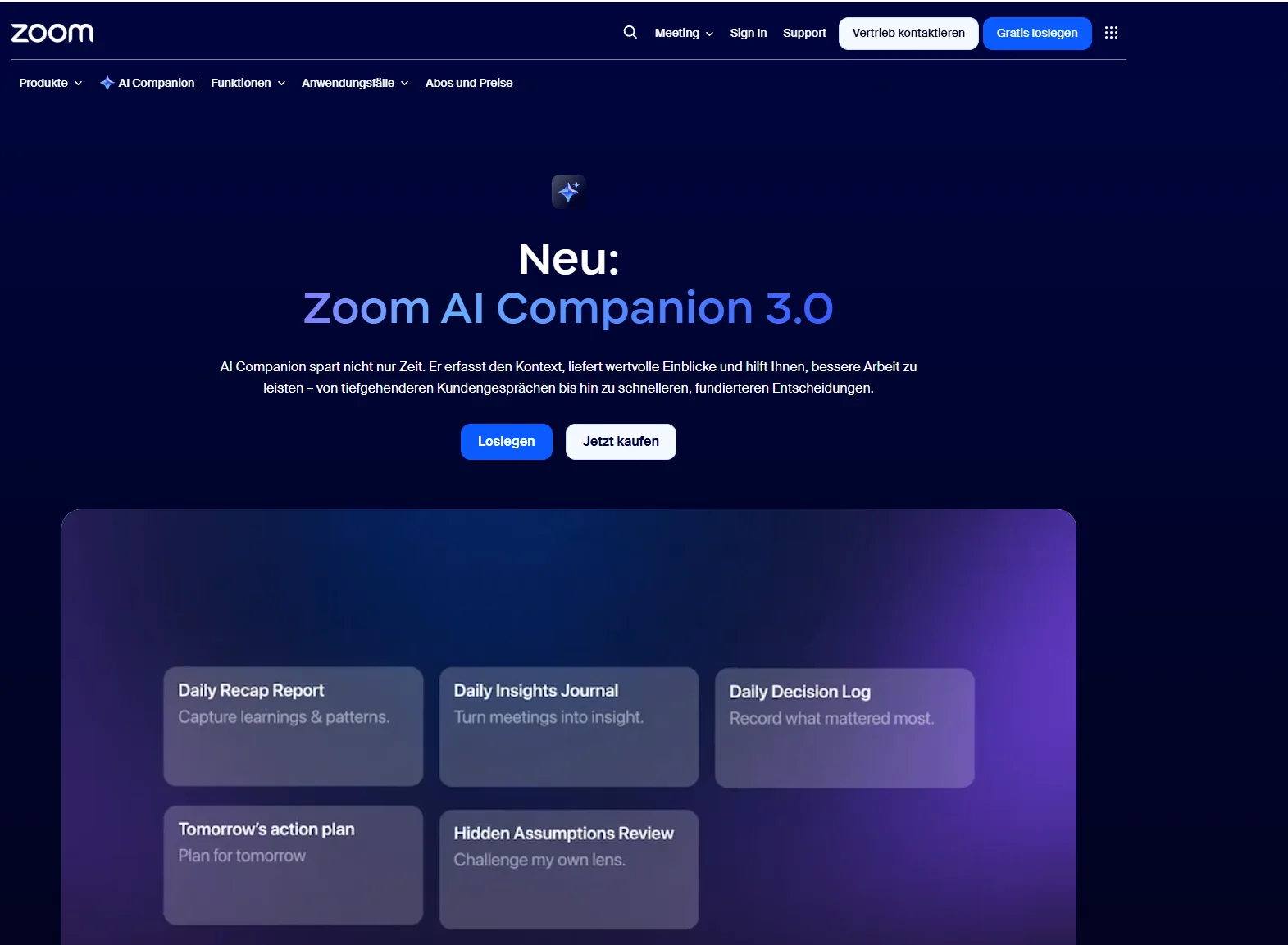
| Zoom erweitert seinen AI Companion um agentische Funktionen, die Routineaufgaben eigenständig übernehmen sollen. | Zoom is expanding its AI Companion with agentic functions that will independently take over routine tasks. |
| In vielen Unternehmen ist die digitale Zusammenarbeit über Jahre organisch gewachsen. Für Meetings, Messaging, Telefonie, Projektarbeit und Kundenkommunikation kamen nach und nach neue Anwendungen hinzu. Was zunächst pragmatisch erschien, hat sich in vielen Organisationen zu einer ernsthaften strukturellen Herausforderung entwickelt: Mitarbeitende wechseln zwischen verschiedenen Tools, Informationen liegen in unterschiedlichen Systemen, und Workflows verlaufen über mehrere Plattformen hinweg. Digitale Kommunikation findet statt – aber selten aus einem Guss.
Mit der zunehmenden Automatisierung von Geschäftsprozessen verschärft sich dieses Problem. Je mehr Zusammenarbeit digital organisiert wird, desto spürbarer wirken sich eine zersplitterte Tool-Landschaft auf Produktivität, Transparenz und Governance aus. Immer mehr Unternehmen beginnen daher, ihre Kommunikationsarchitektur grundlegend zu hinterfragen – und suchen nach Ansätzen, die nicht nur einzelne Funktionen verbessern, sondern die gesamte Zusammenarbeit neu strukturieren. Konsolidierung als strategische AntwortDie Reaktion vieler Organisationen folgt einem klaren Muster: strategische Konsolidierung. Statt isolierter Einzelanwendungen rücken integrierte Plattformen in den Fokus, die zentrale Funktionen wie Meetings, Messaging, Telefonie und Kundeninteraktion unter einem Dach vereinen. Der Vorteil liegt auf der Hand: Informationen bleiben im Kontext, Prozesse laufen über eine gemeinsame Umgebung, und Mitarbeitende arbeiten in einer einheitlichen Nutzererfahrung, die als zusammenhängende Infrastruktur für Zusammenarbeit fungiert. Parallel dazu gewinnt künstliche Intelligenz an Bedeutung in der digitalen Arbeitsumgebung. Automatische Zusammenfassungen, intelligente Suche oder die Ableitung von Aufgaben für agentische Prozesse versprechen spürbare Effizienzgewinne. Ihr volles Potenzial entfalten diese Technologien jedoch nur dort, wo sie auf zusammenhängende Kommunikations- und Arbeitskontexte zugreifen können. Gerade deshalb verstärkt KI den Trend zur Plattform: Je integrierter die Kommunikationsarchitektur, desto wirkungsvoller lässt sich künstliche Intelligenz in den Arbeitsalltag einbinden. KI als Workflow-Motor: Mehr als nur AssistenzImmer häufiger geht es dabei nicht mehr nur um Assistenzfunktionen. Moderne KI-Modelle strukturieren Aufgaben selbstständig, führen Informationen aus verschiedenen Interaktionen zusammen, leiten konkrete Arbeitsschritte ab und führen diese durch. Kommunikation entwickelt sich damit zum Ausgangspunkt automatisierter, agentischer Workflows – einem Paradigmenwechsel in der Art, wie Unternehmen ihre digitale Zusammenarbeit verstehen. Diesen Plattformansatz verfolgt auch der UCaaS-Anbieter Zoom. Das Unternehmen vereint Meetings, Team Chat, Cloud-Telefonie und Drittanbieter-Integrationen in einer gemeinsamen Umgebung. Im Zentrum steht der AI Companion, der Nutzende bei der täglichen Zusammenarbeit unterstützt und nun um agentische KI-Funktionen erweitert wird, die nicht nur reagieren, sondern proaktiv handeln. My Notes und Personal Workflows: Neue Funktionen im Beta-StadiumZwei konkrete Neuerungen stehen im Mittelpunkt der aktuellen Erweiterung des AI Companion: My Notes und Personal Workflows. My Notes sammelt Meeting-Notizen an einem Ort und reichert sie – sofern vorhanden – mit dem jeweiligen Transkript an. Dabei spielt es keine Rolle, ob das Meeting in Zoom selbst, in Präsenz oder auf Drittplattformen wie Microsoft Teams oder Google Meet stattgefunden hat. Der AI Companion erstellt daraus ein personalisiertes Recap, das sich auf die für die jeweilige Person relevanten Punkte fokussiert und Follow-ups sowie offene Aufgaben beschleunigt. Personal Workflows hingegen automatisiert wiederkehrende Handgriffe wie den Versand von Updates oder die Terminierung von Follow-ups und überführt diese in mehrstufige, nahtlose Abläufe. Beide Funktionen befinden sich aktuell in der Beta-Phase und sollen bald allgemein verfügbar sein – sowohl in kostenpflichtigen Zoom Workplace-Accounts als auch als Standalone-Plan. Kostenlose Nutzende können die Funktionen testen, allerdings mit monatlichen Nutzungslimits. Mit diesen Erweiterungen entwickelt sich der AI Companion innerhalb der Zoom-Plattform von einer unterstützenden Funktion zu einem aktiven Bestandteil der täglichen Zusammenarbeit. Teams sollen so Zeit für inhaltliche Arbeit gewinnen – und Kommunikation wird zunehmend zum Ausgangspunkt produktiver, KI-gestützter Workflows. |
In many companies, digital collaboration has organically grown over the years. For meetings, messaging, telephony, project work, and customer communication, new applications were gradually added. What initially seemed pragmatic has developed into a serious structural challenge in many organizations: Employes switch between different tools, information is stored in different systems, and workflows span multiple platforms. Digital communication takes place – but rarely seamlessly.
With the increasing automation of business processes, this problem is becoming more acute. The more collaboration is organized digitally, the more noticeable the impact of a fragmented tool landscape on productivity, transparency, and governance becomes. More and more companies are therefore beginning to fundamentally question their communication architecture – and are looking for approaches that not only improve individual functions but also restructure the entire collaboration. Consolidation as a strategic response The response of many organizations follows a clear pattern: strategic consolidation. Instead of isolated individual applications, integrated platforms are coming into focus, bringing together central functions like meetings, messaging, telephony, and customer interaction under one roof. The advantage is clear: Information remains contextual, processes run thru a shared environment, and employes work in a unified user experience that serves as a cohesive infrastructure for collaboration. At the same time, artificial intelligence is gaining importance in the digital work environment. Automatic summaries, intelligent search, or the derivation of tasks for agentic processes promise noticeable efficiency gains. However, these technologies can only fully realize their potential where they can access coherent communication and work contexts. Precisely for this reason, AI reinforces the trend toward platforms: The more integrated the communication architecture, the more effectively artificial intelligence can be incorporated into everyday work. AI as a Workflow Engine: More than Just Assistance More and more often, it’s no longer just about assistance functions. Modern AI models independently structure tasks, consolidate information from various interactions, derive specific work steps, and execute them. Communication is thus becoming the starting point for automated, agentic workflows – a paradigm shift in the way companies understand their digital collaboration. This platform approach is also being pursued by the UCaaS provider Zoom. The company combines meetings, team chat, cloud telephony, and third-party integrations in a unified environment. At the center is the AI Companion, which supports users in their daily collaboration and is now being expanded with agentic AI functions that not only react but also act proactively. My Notes and Personal Workflows: New Features in Beta Stage Two specific innovations are at the center of the current expansion of the AI Companion: My Notes and Personal Workflows. My Notes collects meeting notes in one place and enriches them—with the respective transcript, if available. It doesn’t matter whether the meeting took place in Zoom itself, in person, or on third-party platforms like Microsoft Teams or Google Meet. The AI Companion creates a personalized recap from this, focusing on the points relevant to the individual and accelerating follow-ups and open tasks. |

Dr. Jakob Jung ist Chefredakteur Security Storage und Channel Germany. Er ist seit mehr als 20 Jahren im IT-Journalismus tätig. Zu seinen beruflichen Stationen gehören Computer Reseller News, Heise Resale, Informationweek, Techtarget (Storage und Datacenter) sowie ChannelBiz. Darüber hinaus ist er für zahlreiche IT-Publikationen freiberuflich tätig, darunter Computerwoche, Channelpartner, IT-Business, Storage-Insider und ZDnet. Seine Themenschwerpunkte sind Channel, Storage, Security, Datacenter, ERP und CRM.
Kontakt – Contact via Mail: jakob.jung@security-storage-und-channel-germany.de